
BMW Self-Balancing Bike Patent: What It Means for India
Every rider knows that moment of panic — you're crawling through a traffic jam, the bike slows almost to a stop, and suddenly you're scrambling to get your foot down before things go sideways. It's awkward at best, dangerous at worst. And on Indian roads, where bumper-to-bumper chaos in cities like ...
Editorial Team
Every rider knows that moment of panic — you're crawling through a traffic jam, the bike slows almost to a stop, and suddenly you're scrambling to get your foot down before things go sideways. It's awkward at best, dangerous at worst. And on Indian roads, where bumper-to-bumper chaos in cities like Bengaluru, Mumbai, and Delhi is practically a daily ritual, that scenario plays out thousands of times every single day.
BMW Motorrad has apparently been thinking hard about this exact problem. A recently surfaced patent filing reveals that the German manufacturer is exploring self-balancing technology for motorcycles — systems that use gyroscopic mechanisms or electronic intervention to keep a bike upright at low speeds or even at a complete standstill, without the rider needing to put a foot down.
Worth being clear here: this is a patent, not a production announcement. Patents get filed all the time, and many never make it to a showroom floor. So while this is genuinely exciting, tempering expectations feels like the right move for now.
Still, the implications are hard to ignore — especially for riding conditions like ours. Could this technology finally make motorcycles more accessible, safer, and less physically demanding in stop-and-go traffic? And what would it actually mean for the future of motorcycling in India?
How Does BMW's Self-Balancing Technology Actually Work?
Think about how electronic stability control works in a car. The moment your vehicle starts to slide or lose traction, sensors detect the deviation and the system corrects it faster than any human reaction could manage. BMW's self-balancing patent appears to apply a similar logic to two wheels — detecting unwanted lean and correcting it before the rider even processes what's happening.
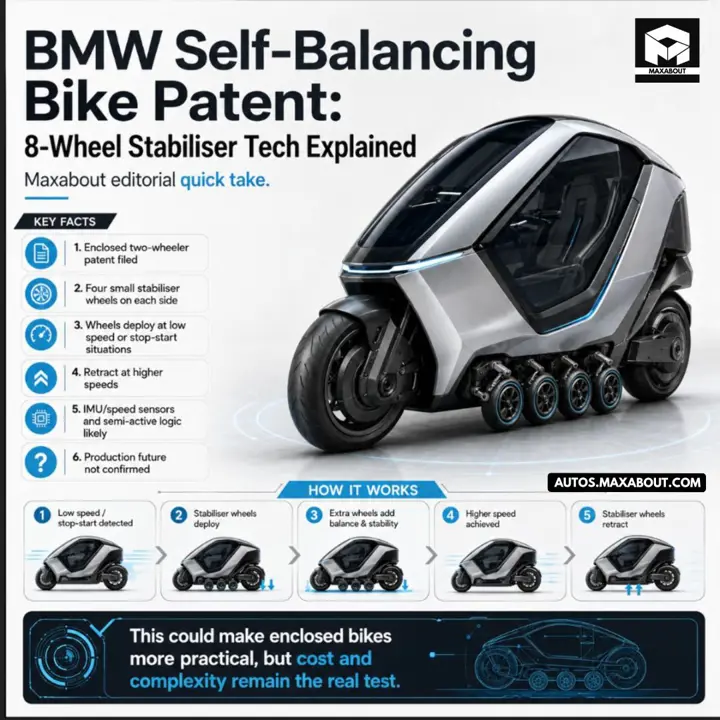 At the core of the system are gyroscopic sensors and electric actuators. The gyroscope continuously monitors the bike's lean angle and orientation. When it detects the bike tipping beyond a controlled threshold — particularly at low speeds or during a standstill — the actuators make micro-corrections, likely by shifting a counterweight or adjusting steering geometry, to restore balance automatically.
Honda explored something similar with their Riding Assist technology, which used a self-steering front fork mechanism to keep the bike upright at low speeds. What BMW's patent apparently adds is a more integrated, sensor-heavy approach — combining lean detection with active mechanical response in a way that could theoretically work across a broader range of speeds and conditions.
That said, a patent describes an intention, not a finished product. The engineering gap between a documented concept and a reliable, road-ready system is enormous. Real-world variables — heat, road surface, sudden weight shifts — are far harder to account for than controlled lab conditions.
Why This Technology Could Be a Game-Changer on Indian Roads
Now here is where things get genuinely interesting for riders in this country. Indian road conditions are, to put it plainly, unforgiving. Anyone who has navigated Pune's waterlogged underpasses during monsoon or crawled through Kolkata's congested ring roads knows that riding demands constant physical micro-adjustments that most people take for granted.
Low-speed tip-overs are among the most common motorcycle mishaps in India — and they almost never involve high-speed drama. It is usually a slippery patch near a signal, a sudden pothole forcing an emergency stop, or simply the weight of a heavy bike becoming unmanageable in bumper-to-bumper traffic. A self-balancing system could intervene precisely in these mundane, frustrating moments.
From what industry observers have noted, newer riders and daily commuters switching to heavier premium motorcycles often struggle most at standstill situations — traffic signals, parking maneuvers, slow crawls. That is exactly where active stabilization would matter most.
BMW Motorrad already has an established presence in India, with models like the G 310 R and the larger R 1250 series attracting urban professionals who genuinely value safety technology. This growing premium segment seems like a natural fit for such innovation.
To be honest though, all of this remains speculative for now. A patent filing is a long way from showroom reality.
The Safety Angle: Could This Reduce Motorcycle Accident Statistics in India?
India's road safety numbers are genuinely difficult to read. Government and industry reports consistently place India among the countries with the highest two-wheeler fatality rates globally. A significant portion of those accidents involve motorcycles and scooters. So when a technology promises better stability, it is natural to ask — could this actually help?
Honestly, the answer is complicated. Self-balancing systems address a specific problem: low-speed instability and tip-overs. Think slow parking maneuvers, sudden stops, or losing balance on uneven surfaces. For those scenarios, yes, this technology could make a real difference.
But high-speed crashes follow entirely different physics. A rider colliding at 80 kmph on a highway has problems no gyroscope can solve. Overconfidence becomes the real danger here. If riders start believing electronic aids will catch every mistake, that psychological shift could actually increase reckless behavior.
A useful parallel already exists in India. Mandatory ABS adoption on bikes above 125cc has shown measurable reductions in braking-related accidents since its implementation. That is encouraging evidence that the right technology, properly deployed, genuinely saves lives.
Self-balancing could follow a similar path — but only if riders understand its limitations clearly. It is a useful safety layer, not a complete solution.
Potential Challenges and Drawbacks of Self-Balancing Systems
Being realistic here — this technology comes with some serious question marks, and they deserve honest discussion.
Cost is the obvious starting point. BMW Motorrad already sits in premium territory. Adding sophisticated gyroscopic actuators and the supporting electronics will push prices further. From what industry observers suggest, advanced balancing systems could add anywhere from ₹1.5 lakh to ₹3 lakh to a motorcycle's price. That narrows the audience considerably.
Then there is the reliability question — particularly relevant for Indian conditions. Dust from Rajasthan highways, monsoon moisture in Mumbai, extreme summer heat in Nagpur, and the relentless punishment of broken urban roads create an environment that stresses electronics aggressively. A gyroscope spinning at high speeds inside a vibrating motorcycle frame, exposed to these conditions repeatedly, raises genuine durability concerns.
Maintenance is perhaps the most practical worry. If this system develops a fault, can BMW Motorrad service centers in Tier-2 cities actually diagnose and repair it? Specialized calibration equipment and trained technicians are not guaranteed outside major metros. A failed balancing system could leave a rider stranded with an expensive, unrideable machine.
Weight addition also matters. Gyroscopes and actuators are not light components, and every extra kilogram affects handling feel at corner entry.
Finally, many experienced riders simply do not want this. The mechanical connection between rider and road is central to why motorcycling feels different from driving a car. Electronic intervention, however intelligent, changes that conversation fundamentally.
BMW Motorrad in India: Premium Bikes and Rising Expectations
BMW Motorrad has built a genuine foothold in India, not just a showroom presence. Their locally assembled models — particularly the G 310 R and G 310 GS — have brought the badge within reach of serious enthusiasts without the full import price tag. Above that, bikes like the S 1000 RR and R 1250 GS attract buyers who have done their research thoroughly and know exactly what they want.
The premium motorcycle segment in India is growing, concentrated largely in cities like Bengaluru, Mumbai, Pune, and Delhi. These buyers are not impulse purchasers. Many track every spec, follow international motorcycle media closely, and compare ownership experiences in detail.
That tech-savviness matters here. Safety and rider assistance technology genuinely influences purchase decisions at this price point. Cornering ABS, traction control, multiple riding modes — these are now expected, not impressive.
But value-for-money thinking does not disappear just because someone is spending ₹5 lakh or ₹20 lakh. If anything, the scrutiny increases. Premium buyers want to understand precisely what justifies the price difference. A self-balancing system would face that same question — what practical problem does this solve for me, on Indian roads, in daily conditions? That is the conversation BMW Motorrad would need to win.
When Might This Technology Reach Production — And What Should Indian Buyers Expect?
Here is the honest answer: nobody really knows. And that is not pessimism — that is just how patent-to-production timelines work in the automotive world.
A patent filing means a company has protected an idea. It does not mean that idea is heading to a showroom anytime soon. Many patents never become products at all. They exist as insurance, as research documentation, or as signals of a technical direction. The journey from a patent drawing to a production-ready system involves engineering validation, cost reduction, regulatory approval, and eventually, market pricing — each stage capable of adding years to the timeline.
Consider cornering ABS. The underlying technology existed well before it became mainstream. Semi-active suspension followed a similar path — first appearing on high-end European motorcycles before gradually becoming more accessible. Both took the better part of a decade to move from niche innovation to something buyers could reasonably expect. Self-balancing systems, being significantly more complex, could take longer.
For India specifically, the realistic expectation is that we would be a later market rather than an early one. That is not a criticism — it simply reflects pricing realities and how premium motorcycle technology typically rolls out globally. When such a system does arrive, it will almost certainly debut on flagship models well above ₹20 lakh before any broader adoption becomes possible.
The smarter approach right now is to follow official BMW Motorrad announcements rather than reading too deeply into patent filings. When the technology is ready, BMW will say so clearly. Until then, this remains a genuinely exciting direction for motorcycling — proof that the industry is still asking bold questions about rider safety and accessibility, even if the answers are still some years away.
Final Thoughts: Is Self-Balancing the Next Big Leap for Motorcycles?
Honestly? I think this matters more than most people are willing to admit right now.
Self-balancing technology is easy to dismiss as a solution looking for a problem — until you picture a daily commuter on a rain-soaked road in Pune, or someone navigating the chaotic stop-and-go traffic of Old Delhi at rush hour. Falls happen at low speeds. Fatigue causes wobbles. These are not edge cases in India — they are Tuesday morning.
So when a manufacturer like BMW starts seriously exploring gyroscopic stabilisation, the right response is cautious optimism, not cynicism. The core idea is genuinely meaningful for rider safety, even if the execution is still years from being production-ready or remotely affordable.
Will it feel different to ride? Almost certainly. Will traditionalists push back? Absolutely. But motorcycling has absorbed major technology shifts before and survived just fine.
For a country with millions of two-wheeler commuters facing genuinely punishing road conditions every single day, any technology that reduces falls deserves serious attention — not hype, but attention.
Would you want a self-balancing motorcycle, or does it feel like unnecessary complexity? Drop your thoughts below.
Explore the story
Related news


Share your view and join the discussion.
Earn reward points for every comment and get a chance to win ₹1,000 in our weekly lucky draw. Sign in with Google in one tap.
Start the conversation
No one has commented on this article yet. Be the first to share your view.
Want to read more automotive news?
Stay updated with the latest car launches, reviews, and industry insights.
Browse All News