
BGauss BG-PinkE Scooter Concept: IPL Rajasthan Royals Reveal
Something a little unexpected happened recently in the world of Indian electric scooters. BGauss, a Mumbai-based electric two-wheeler brand, unveiled a concept scooter called the BG-PinkE — and they chose to do it through a partnership with the Rajasthan Royals during the IPL. Not at an auto expo. N...
Editorial Team
Something a little unexpected happened recently in the world of Indian electric scooters. BGauss, a Mumbai-based electric two-wheeler brand, unveiled a concept scooter called the BG-PinkE — and they chose to do it through a partnership with the Rajasthan Royals during the IPL. Not at an auto expo. Not through a press release buried in a trade publication. Through cricket.
If you haven't heard of BGauss before, you're not alone. The brand has been operating somewhat under the radar, steadily building its lineup of electric scooters without making enormous amounts of noise. They're a serious player in the space, but they haven't had the kind of mainstream visibility that brands like Ola Electric or Ather have enjoyed.
That's precisely what makes this IPL tie-up interesting. It signals a deliberate shift in strategy — from speaking to early EV adopters who already follow the segment closely, to reaching a much wider audience that may never have walked into an electric scooter showroom.
One thing worth flagging immediately: the BG-PinkE is a concept reveal, not a production announcement. That distinction genuinely matters. Concepts often look spectacular and then quietly disappear, or arrive in a very different form. From what's known so far, buyers should stay curious but measured.
What Exactly Is the BG-PinkE? Breaking Down the Concept Scooter
Visually, the BG-PinkE leans hard into Rajasthan Royals' signature pink-and-white color palette. The scooter's bodywork carries that bold pink prominently, with white accents creating contrast across the panels. It reads more like a lifestyle statement than a utilitarian commuter — which, honestly, seems entirely intentional.
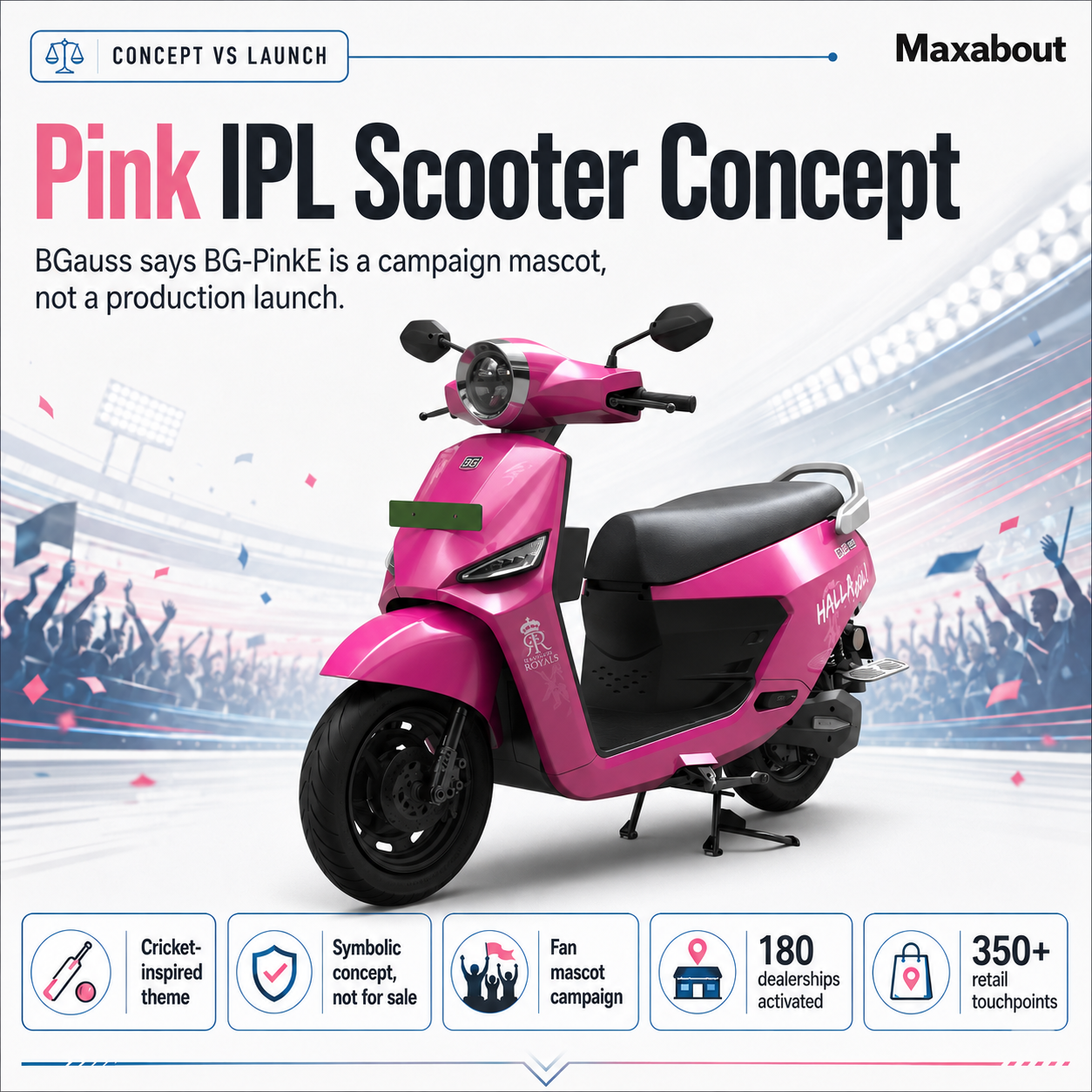 BGauss has not released detailed technical specifications for this concept. No confirmed range figures, battery capacity, or motor output numbers have been officially announced. What exists right now is largely a design study — a visual direction rather than a production-ready blueprint.
Comparing it aesthetically to existing BGauss models like the B8 or A2i, the BG-PinkE feels considerably more expressive. Current BGauss scooters follow a relatively conventional design language — clean, practical, nothing polarizing. The BG-PinkE breaks that pattern noticeably.
Whether that bold styling translates well to Indian roads is a fair question. Bright pink paintwork in dense city traffic, dust-heavy conditions like Jaipur's outskirts, or monsoon-soaked Mumbai streets — that finish would demand serious maintenance attention.
Crucially, BGauss has not indicated any confirmed production timeline. This remains a concept reveal tied to an IPL moment, and whether it ever reaches showroom floors — in this form or otherwise — is genuinely unclear right now.
Why IPL Partnerships Are Becoming a Serious Strategy for EV Brands in India
Step back from the BG-PinkE for a moment. The more interesting story here might actually be why an EV brand like BGauss is investing in IPL visibility at all.
The logic is straightforward. Most Indian buyers — particularly in smaller cities and semi-urban areas — do not actively research electric two-wheelers. They are not reading spec sheets or comparing range figures. But they are watching IPL. Reaching that audience through cricket sponsorship is genuinely efficient in a way that digital advertising often is not.
For BGauss, associating with Rajasthan Royals puts the brand in front of a young, aspirational audience across Rajasthan, Gujarat, and beyond. That demographic overlap with potential first-time EV buyers is not accidental.
That said, IPL sponsorships are expensive. For a smaller EV brand competing against Ola Electric and TVS, that investment carries real risk. Brand awareness does not automatically convert to sales. The honest reality is this kind of partnership is long-term brand building — not an immediate sales trigger. Whether BGauss has the financial runway to sustain that strategy is a fair question worth watching.
BGauss as a Brand: Where Do They Stand in India's Crowded Electric Scooter Market?
BGauss is a Mumbai-based electric scooter brand that launched in 2020 under RR Global, a well-established electrical components manufacturer. That industrial background matters — it is not a startup built entirely on investor money and optimism. There is actual manufacturing and supply chain experience behind the brand, which gives it a degree of credibility that pure-play EV startups sometimes lack.
Their current lineup includes models like the B8 and D15i, priced roughly in the ₹90,000 to ₹1.15 lakh range. These are positioned as practical, mid-segment commuter scooters — not performance machines. Real-world range figures from owner feedback suggest somewhere between 70 to 90 kilometres on a full charge depending on riding conditions, which is reasonable for city use but not exceptional compared to what segment leaders now offer.
Build quality reviews have been mixed but largely decent for the price point. Nothing extraordinary, but not alarming either. The more genuine concern is their service network. Outside major metros like Mumbai, Pune, and Bengaluru, finding an authorised BGauss service centre becomes noticeably harder. For buyers in smaller cities or Tier-2 towns, that is a real practical limitation worth factoring in.
Against segment leaders like Ola Electric, TVS iQube, and Bajaj Chetak, BGauss remains a smaller player with limited market share. They are credible — but not dominant. The question around the BG-PinkE concept is fair: the foundation exists, but execution at scale is still something they need to prove.
The Pink Branding Angle: Smart Marketing Move or a Narrow Audience Play?
Let's be honest about what BGauss is doing here. Naming a concept scooter "PinkE" and tying it to Rajasthan Royals — a team literally built around the color pink — is a deliberate, calculated branding choice. The question worth asking is whether that choice opens doors or quietly closes some.
There is a genuinely compelling case for targeting women riders more directly. India's women rider segment remains remarkably underserved. Most electric scooters are designed with a generic rider profile in mind — seat heights, handlebar reach, storage decisions — none of it particularly thoughtful toward the practical needs of women navigating daily commutes in cities like Jaipur, Pune, or Chennai. A scooter marketed thoughtfully toward that audience could fill a real gap.
From what industry observers have noted, women buyers increasingly influence or outright make two-wheeler purchase decisions in urban households. A product that speaks directly to that demographic — not condescendingly, but practically — has genuine commercial logic behind it.
That said, reducing a product's identity to a single color carries risk. Pink as a marketing hook can feel superficial if the substance underneath doesn't hold up. What ultimately matters is whether the BG-PinkE delivers on range, ride comfort through stop-and-go traffic, practical seat height, under-seat storage, and accessible service support — regardless of who is riding it.
Concept vs. Reality: What Indian Buyers Should Watch For Before Getting Excited
Here is where I'd encourage everyone to slow down a little. A concept reveal at an IPL event is exciting, but it is not a product launch. There is a meaningful distance between what gets unveiled under stadium lights and what eventually reaches a showroom floor.
India's EV two-wheeler space has a complicated history with hype cycles. Several manufacturers have announced bold concepts with impressive claimed figures, only for timelines to stretch by a year or more — and for final production versions to look noticeably different from the original reveal. That's not unique to India, but buyers here have learned some hard lessons.
So before getting too invested, watch specifically for these signals:
A confirmed production announcement — not just a concept showcase
ARAI-certified range figures, not manufacturer claims, which often reflect ideal conditions rather than real-world Bengaluru or Delhi traffic
Actual showroom pricing with variant-level clarity
Service center availability in your specific city before committing
Stay interested — the BG-PinkE concept is genuinely worth following. Just treat it as a conversation starter, not a buying signal. That distinction matters.
What Would Make the BG-PinkE Worth Buying? A Practical Wishlist
Setting aside the concept excitement for a moment — if BGauss actually wants this scooter to sell, here is what genuinely needs to happen at launch.
Real-world range above 80 km is non-negotiable. Not ARAI numbers. Not highway-speed test figures. Actual stop-start city riding range in Pune or Hyderabad traffic, with the headlight on and occasional phone charging. Anything below that threshold makes daily commuters anxious about range every single morning.
Charging time matters just as much. A full charge under four hours would make a meaningful difference for riders without dedicated parking or home charging setups — which describes a large portion of apartment dwellers across Indian cities.
Ground clearance deserves serious attention too. Broken stretches, speed breakers stacked back to back, waterlogged patches during monsoon — these are not edge cases in Indian cities, they are daily reality.
On pricing, positioning this anywhere above ₹1.1 to ₹1.3 lakh (on-road) without a genuinely strong feature set would be a tough sell against established competition. And the service network must reach beyond metros — smaller cities need support too.
Get these fundamentals right, and the BG-PinkE has a real shot.
Final Thoughts: Interesting Concept, But the Proof Will Be in the Production Version
Look, I will be honest — the BGauss and Rajasthan Royals partnership is genuinely clever. For a mid-sized EV brand still building its identity, attaching yourself to one of cricket's most visible franchises shows real ambition. The BG-PinkE concept turns heads, sparks conversation, and puts BGauss in rooms it probably was not in before.
That matters. Brand visibility in this crowded market is not nothing.
But India's electric scooter buyers have been through enough concept reveals and launch-event enthusiasm to know better than to get carried away. Pretty renders do not navigate potholes. Bold promises do not replace certified range numbers and real-world ownership costs.
So here is the most honest takeaway I can offer — watch BGauss closely, but watch patiently. Wait for official production announcements. Wait for ARAI-certified range figures. Wait for confirmed pricing and a clear picture of their service reach outside major cities.
If they deliver on the fundamentals, this could be a genuinely interesting story to follow. And right now, that is the most accurate thing anyone can say.
Explore the story
Related news
Share your view and join the discussion.
Earn reward points for every comment and get a chance to win ₹1,000 in our weekly lucky draw. Sign in with Google in one tap.
Start the conversation
No one has commented on this article yet. Be the first to share your view.
Want to read more automotive news?
Stay updated with the latest car launches, reviews, and industry insights.
Browse All News