
Battery PLI Delays Threaten India's EV Cell Localization Plan
India's Battery PLI scheme delays have exposed a major gap in the country's EV cell localisation roadmap. The Rs 18,100 crore Advanced Chemistry Cell programme has awarded 40 GWh of capacity, but only 1.4 GWh is installed so far, according to the latest reported status. The original commercial produ...
Editorial Team
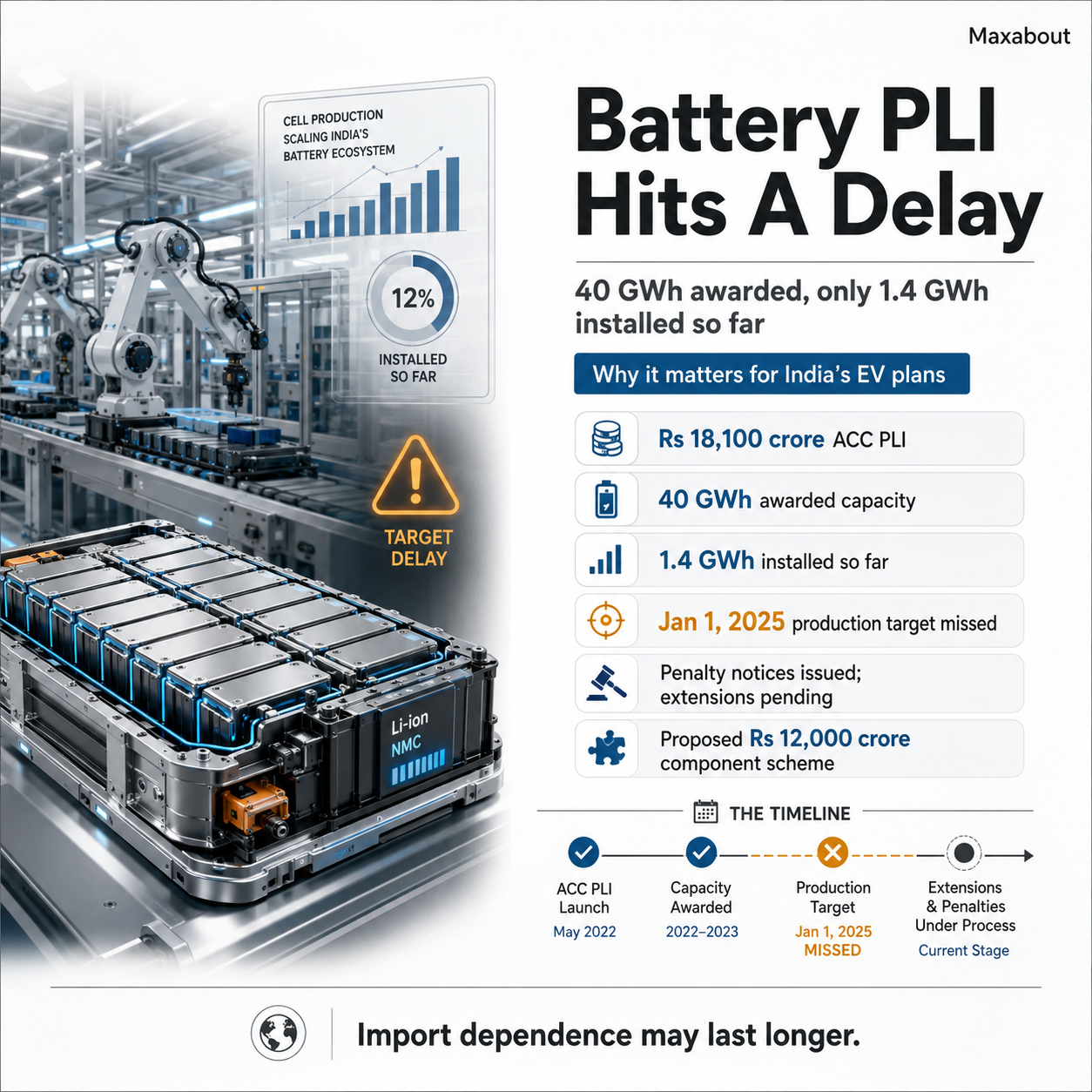
India's Battery PLI scheme delays have exposed a major gap in the country's EV cell localisation roadmap. The Rs 18,100 crore Advanced Chemistry Cell programme has awarded 40 GWh of capacity, but only 1.4 GWh is installed so far, according to the latest reported status. The original commercial production target was January 1, 2025, and extension requests are still pending.
What you need to know
The ACC battery PLI scheme has a stated outlay of Rs 18,100 crore.
The awarded manufacturing capacity stands at 40 GWh.
Installed capacity is reported at only 1.4 GWh so far.
The January 1, 2025 production-start target has been missed.
Quarterly penalty notices have reportedly been issued, but penalties have not been realised while extension requests remain pending.
A separate Rs 12,000 crore battery-components incentive is reportedly under inter-ministerial consultation.
Why the ACC battery PLI delay matters
The ACC PLI programme was designed to reduce India's dependence on imported advanced chemistry cells and create a globally competitive local battery ecosystem. That matters because batteries are one of the most expensive and strategically important parts of an electric vehicle.
If domestic cell manufacturing slips, Indian EV makers may continue relying on imported cells for longer than expected. That can affect localisation targets, supply security, pricing flexibility and the pace at which India can build a deeper EV component base.
Capacity snapshot
| Metric | Reported status |
|---|---|
| Scheme outlay | Rs 18,100 crore |
| Awarded ACC capacity | 40 GWh |
| Installed capacity so far | 1.4 GWh |
| Original production-start target | January 1, 2025 |
| Current penalty status | Penalty notices issued; realisation pending while extension requests are considered |
| Additional policy proposal | Rs 12,000 crore battery-components incentive under consultation |
The penalty and extension issue
The scheme reportedly includes penalty clauses tied to missed installation timelines. After the January 1, 2025 target was missed, the Ministry of Heavy Industries is reported to have issued quarterly penalty notices. However, the penalties have not yet been realised because beneficiaries have sought timeline extensions and those requests are awaiting a decision.
This distinction is important: the latest status does not mean penalties have been waived. It means the enforcement outcome is still linked to the pending extension decision.
Which companies are affected?
The 40 GWh capacity was awarded across major beneficiaries including Ola Electric, Reliance Industries-linked SPVs, and ACC Energy Storage / Rajesh Exports. Ola Electric is cited as the only producer so far, with reported output of about 40,000 cells per month and installed capacity of 1.4 GWh.
Reliance is expected to come on stream later, while the Rajesh Exports-linked allocation has additional legal and regulatory complexity. Any final decision on capacity reallocation or eviction would need to follow the applicable programme terms and legal process.
The China-linked supply-chain bottleneck
A major reason cited for the slow rollout is dependence on China-linked technology, capital goods and raw materials such as lithium. Battery cell manufacturing needs more than factory space; it needs equipment, materials, process know-how, trained teams and stable supply chains.
This is why the proposed battery-components incentive matters. If approved, it could support local production of inputs such as cathode active materials, anode active materials and copper foil separators. However, the proposal is still at the consultation stage and may take time before final approval.
What it means for Indian EV buyers and the industry
For buyers, the immediate showroom impact may not be obvious, because EV makers can still source cells through imports. The larger issue is long-term: slower localisation can keep India exposed to global battery price swings, supply disruptions and currency pressure.
For manufacturers, the delay complicates planning. Local cell production is central to deeper value addition, cost control and strategic independence. Until domestic capacity scales beyond the current reported level, India's EV ecosystem remains partly dependent on external battery supply chains.
FAQs
What is the ACC Battery PLI scheme?
It is India's production-linked incentive programme for Advanced Chemistry Cell battery manufacturing, aimed at building domestic battery cell capacity and reducing import dependence.
How much capacity was awarded under the scheme?
The awarded capacity is reported at 40 GWh, while installed capacity so far is reported at 1.4 GWh.
Have penalties been collected from delayed beneficiaries?
Penalties have reportedly not been realised so far because beneficiaries have requested timeline extensions. A final decision on those extensions is still pending.
Does this delay mean India's EV plan has failed?
No. It means the localisation timeline is under pressure. The policy goal remains important, but execution depends on capacity installation, supply-chain access, component localisation and clear decisions on pending extension requests.
The Battery PLI scheme delays show that India's EV cell localisation challenge is not just about announcing capacity. The next milestone is converting awarded GWh into real production while reducing dependency on imported technology, equipment and battery materials.
Explore the story
Related news

Share your view and join the discussion.
Earn reward points for every comment and get a chance to win ₹1,000 in our weekly lucky draw. Sign in with Google in one tap.
Start the conversation
No one has commented on this article yet. Be the first to share your view.
Want to read more automotive news?
Stay updated with the latest car launches, reviews, and industry insights.
Browse All News