
Bajaj Chetak Production to Scale Up as Bajaj Auto Eyes Global EV Markets
There is something almost poetic about the name Chetak making headlines again — except this time, it is not about a two-stroke scooter puttering through Old Delhi lanes. It is about an electric scooter being readied for showrooms far beyond India's borders.Bajaj has officially announced plans to sca...
Editorial Team
There is something almost poetic about the name Chetak making headlines again — except this time, it is not about a two-stroke scooter puttering through Old Delhi lanes. It is about an electric scooter being readied for showrooms far beyond India's borders.
Bajaj has officially announced plans to scale up Chetak production significantly and push the brand into international markets. For a name that basically lived inside Indian family memories for decades, this is a genuinely big moment. Not just for Bajaj as a company, but for what it signals about where Indian manufacturing and EV ambition are heading.
Think about it. India is already one of the fastest-growing electric two-wheeler markets in the world. But exporting that story — sending a made-in-India electric scooter to compete globally — is a different challenge entirely. It requires build quality, after-sales infrastructure, and brand confidence that meets international expectations.
For everyday riders in cities like Pune, Hyderabad, or Bengaluru, this development matters too. More production volume typically means better availability, competitive pricing, and faster service network expansion. What starts as a global push often circles back to benefit the home market first.
This is worth watching closely.
The Production Scale-Up: What Bajaj Is Actually Planning
Bajaj has not been shy about acknowledging that Chetak supply has struggled to keep pace with demand. In several cities, waiting periods stretched well beyond what buyers typically tolerate. That bottleneck appears to be the core motivation behind what is now a fairly serious production expansion effort.
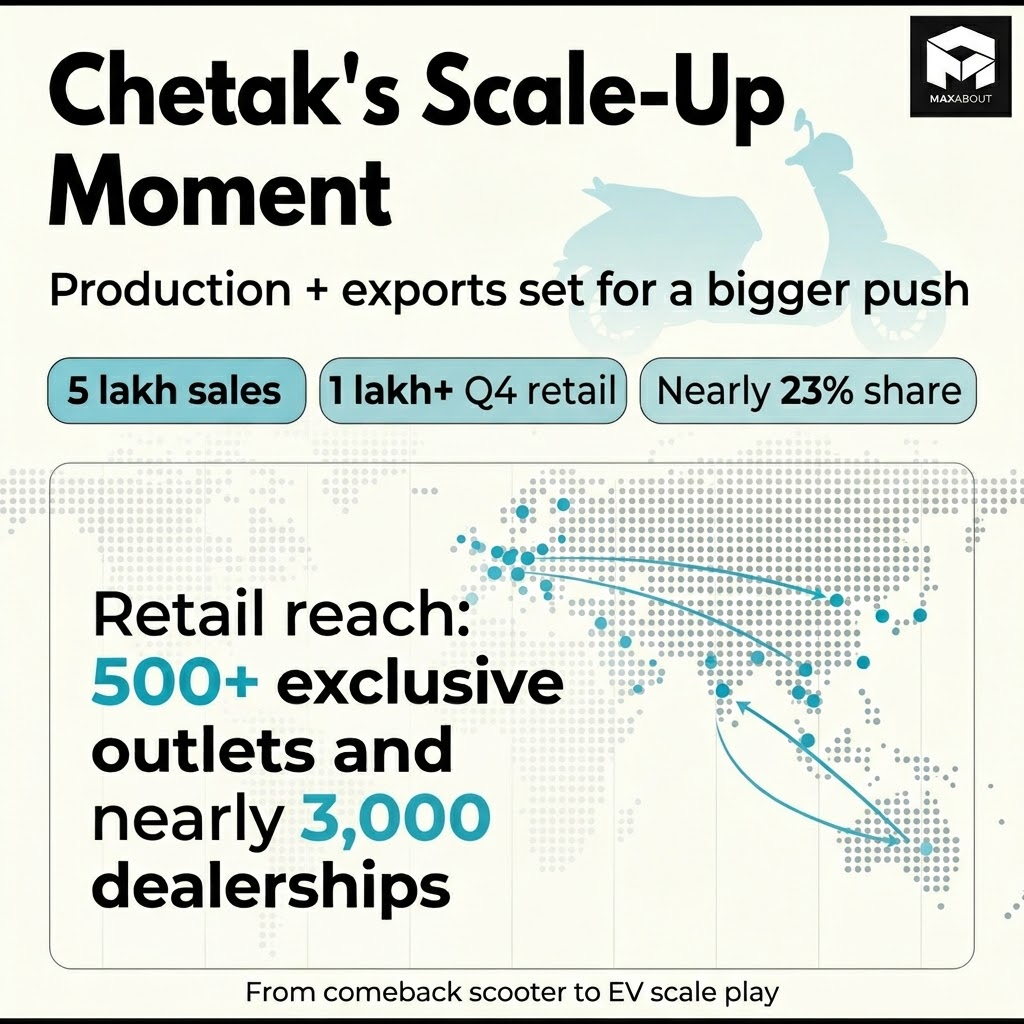 The Chakan facility near Pune currently anchors Chetak manufacturing. According to industry reports, Bajaj has been investing in expanding capacity at this plant, with targets that reportedly aim to push monthly output significantly higher than earlier levels. Some estimates point toward scaling production into the tens of thousands of units monthly, though official figures have been selectively disclosed.
Scaling up is not simply a matter of adding assembly lines. Battery supply chains are the real constraint. Cell sourcing, pack assembly, and quality consistency all need to move in sync. Bajaj has been working on localising more of its battery supply to reduce dependence on imports and manage costs more predictably.
Component sourcing for motors, controllers, and chassis parts also requires vendor ecosystem development — something that takes time to build responsibly. Workforce training for EV-specific assembly is another layer that cannot be rushed without affecting quality.
From what recent announcements suggest, Bajaj is approaching this methodically rather than aggressively, which is probably the smarter approach given the stakes involved.
Which Global Markets Is Bajaj Targeting With the Chetak?
Scaling up production domestically is one challenge. Convincing riders in other countries to choose a Chetak over established local options is an entirely different conversation.
From what industry reports and official announcements suggest, Bajaj is looking at South and Southeast Asia as natural first steps — markets like Sri Lanka, Nepal, Bangladesh, and potentially Indonesia or Vietnam. The logic is straightforward. Two-wheeler culture is deeply embedded in these regions, urban congestion is a daily reality, and rising fuel prices are pushing consumers toward electric alternatives. The Chetak's positioning fits that context reasonably well.
Parts of Europe also appear to be on the radar, particularly for urban commuter segments. Several European cities have aggressive emission reduction targets, and smaller electric scooters occupy a genuine niche there. Latin America is another region worth watching, given growing EV incentive programs in countries like Colombia and Chile.
That said, being honest about the challenges matters here. Regulatory homologation across different markets is expensive and time-consuming. Competing with brands that already have established service networks and local trust is genuinely difficult. Hero and TVS have attempted international pushes with mixed results — Bajaj will need to learn from those experiences rather than repeat them.
Ambition is good. Execution, as always, is where it gets complicated.
How the Chetak Stacks Up Today: Strengths and Real Limitations
Step back from the global ambitions for a moment and look at what the Chetak actually is as a product right now. The honest answer is: genuinely good in some areas, still unfinished in others.
The build quality stands out immediately. The metal body feels substantial in a segment flooded with plastic-heavy scooters. Ride refinement is another strong point — the suspension handles urban road imperfections reasonably well, and braking feels confident. Bajaj's widespread service network adds real peace of mind, something newer electric brands simply cannot offer yet.
The connected features work reliably, and the overall refinement suggests Bajaj took the product seriously rather than rushing something to market.
But the limitations are real. Range remains a genuine concern for riders covering longer daily commutes. The design, while clean, plays it safe compared to more aggressive-looking rivals. And the pricing — sitting around ₹1.15–1.20 lakh — puts it directly against strong competition that offers more range or sharper styling at similar figures.
On congested city roads, in tight parking spots, through Mumbai's waterlogged lanes or Bengaluru's broken stretches — the Chetak performs capably. It is not the most exciting choice, but it is a considered one. For buyers who prioritise reliability and after-sales trust over cutting-edge specs, that matters quite a lot.
The Domestic Competition: Can Chetak Hold Its Ground While Expanding Abroad?
The electric scooter market in India looks very different today than it did even two years ago. Ola Electric has pushed aggressively on both pricing and volume. Ather Energy continues refining its product with genuine engineering credibility. TVS iQube has quietly built a loyal following, backed by one of the country's most trusted service networks. And newer names keep arriving. The space has become genuinely crowded, and Bajaj cannot afford to treat the domestic market as settled ground.
This is precisely where the global expansion ambition raises a fair concern. Scaling production for export markets demands capital, engineering bandwidth, and management attention — all finite resources. If Bajaj's focus drifts toward meeting European compliance requirements or building overseas distribution, the Chetak's domestic product roadmap could quietly stagnate. That would be a costly mistake.
From what industry observers note, buyers in this segment are increasingly demanding more range, faster charging, and sharper feature updates on shorter cycles. The Chetak's current range figures, while adequate for urban use, are no longer a differentiator. Rivals have raised the bar considerably.
To stay genuinely competitive at home while building abroad, Bajaj needs to move on a few fronts simultaneously — meaningful range improvements, more frequent software updates, and a pricing strategy that justifies the premium over hungrier competitors. Global ambition is admirable. But the domestic foundation needs constant reinforcement, not just maintenance.
What a Global Chetak Could Mean for Indian EV Manufacturing
Step back from the product itself for a moment. If Bajaj manages to export the Chetak at meaningful volumes — not just token shipments to a handful of markets — the implications stretch well beyond one company's balance sheet.
It would essentially signal that India can engineer mid-premium electric vehicles that meet international safety, quality, and performance benchmarks. That is not a small thing. The default assumption in most export markets is that Indian two-wheelers compete purely on price. A credibly positioned Chetak challenges that narrative directly.
The downstream effects matter too. Scaled export demand creates real commercial incentive for Indian battery cell manufacturers, motor suppliers, and electronics firms to invest in capacity and quality. Component ecosystems do not mature in isolation — they need volume commitments to justify the capital. Global Chetak orders could provide exactly that kind of pull.
There is also the policy dimension. India's Production Linked Incentive scheme for advanced chemistry cells and EV components was specifically designed to build this kind of manufacturing depth. Bajaj scaling internationally would represent a measurable return on that policy investment — something industry observers and policymakers have been waiting to point to.
For other domestic brands watching closely, a successful Bajaj export story removes a significant psychological barrier. The question shifts from whether Indian EVs can compete globally to how quickly others can follow.
Should You Buy the Chetak Now or Wait?
If you're currently sitting on the fence about the Chetak, this global expansion news is worth pausing on — but probably not in the way you'd expect.
The most reassuring signal here is long-term commitment. Bajaj is clearly not treating the Chetak as a side project. When a manufacturer starts fine-tuning a product for international markets, parts availability and service support tend to follow. That matters enormously for resale value three or four years down the line.
On the practical side, scaling production typically means faster delivery timelines and potentially more competitive pricing as manufacturing costs stabilize. Both are genuine wins for prospective buyers in cities like Pune, Hyderabad, or Bengaluru where waiting periods have occasionally frustrated customers.
There's also an interesting upside worth considering — as Bajaj refines the Chetak to meet stricter global range and safety benchmarks, those improvements often quietly find their way back into domestic variants. Future Chetak buyers could benefit from engineering upgrades driven entirely by export requirements.
That said, buying today means accepting the current range limitations. If longer battery range is your priority, watching the next six months of announcements seems reasonable. But if reliability and brand confidence matter most, the timing honestly looks quite solid right now.
Final Thoughts: Ambition Is Good, But Execution Is Everything
Bajaj's push to scale the Chetak and take it global is genuinely exciting. This is an iconic nameplate carrying real emotional weight, now being repositioned as a serious electric contender on the world stage. That takes courage, and it deserves acknowledgment.
But ambition alone does not win international markets. Consistent build quality, dependable after-sales support abroad, and the flexibility to adapt to local preferences — these are the actual battlegrounds. Europe and other target regions have demanding consumers who will not forgive early reliability issues or sparse service networks.
For Indian buyers, the picture is more straightforward. A production scale-up means better availability, potentially steadier pricing, and engineering refinements driven by export-grade standards filtering back home. That is a meaningful indirect benefit.
The competitive pressure domestically remains real, and Bajaj cannot afford complacency on either front simultaneously.
Ultimately, the Chetak's global story is still being written. The foundation looks promising. Whether execution matches the ambition — that answer is still ahead of us.
If you were living abroad, would you trust an Indian-made electric scooter over a locally established brand? That conversation feels worth having.
Explore the story
Related news
Share your view and join the discussion.
Earn reward points for every comment and get a chance to win ₹1,000 in our weekly lucky draw. Sign in with Google in one tap.
Start the conversation
No one has commented on this article yet. Be the first to share your view.
Want to read more automotive news?
Stay updated with the latest car launches, reviews, and industry insights.
Browse All News