
Bajaj Avenger 220 Street Launch Soon – 160 Discontinued
The Bajaj Avenger has always had something special about it. In a market crowded with commuter bikes and sporty nakeds, it carved out a quiet, loyal following among riders who just wanted to cruise — low seat, relaxed posture, no drama. That reputation has held up for years now.So when news broke th...
Editorial Team
The Bajaj Avenger has always had something special about it. In a market crowded with commuter bikes and sporty nakeds, it carved out a quiet, loyal following among riders who just wanted to cruise — low seat, relaxed posture, no drama. That reputation has held up for years now.
So when news broke that the Avenger 160 Street has been quietly discontinued, it caught quite a few people off guard. And almost immediately after, whispers about an Avenger 220 Street comeback started making rounds. Based on recent industry chatter and official dealership communications, it looks like Bajaj is making a deliberate move here — not abandoning the Avenger nameplate, but repositioning it.
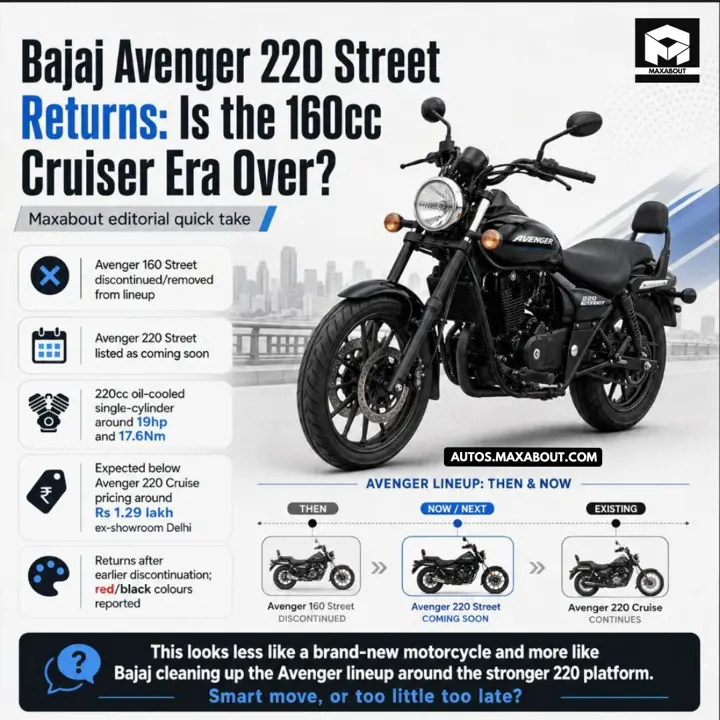 This shift actually matters more than it might seem on the surface. If you were considering the 160 Street as a budget-friendly entry into cruiser riding, that option is now off the table. But the incoming 220 Street could offer a meaningfully better package — more displacement, more presence on the road, and hopefully a price point that still makes sense for the Indian buyer.
For existing Avenger fans, this is worth watching closely. Bajaj appears to be consolidating its cruiser strategy rather than spreading thin across multiple variants. Whether that works in buyers' favour remains to be seen.
Why Bajaj Pulled the Plug on the Avenger 160 Street
The Avenger 160 Street's exit wasn't exactly a surprise to anyone paying attention to sales trends. From what industry observers have noted over the past couple of years, the bike was quietly struggling to find buyers in meaningful numbers. And honestly, it's not hard to understand why.
The ₹1.1 to ₹1.4 lakh price bracket is brutally competitive. At that range, buyers today are spoiled for choice — performance-oriented options with aggressive styling, better power figures, and more modern feature sets are all fighting for the same wallet. A cruiser-style motorcycle with a 160cc engine sits in an awkward middle ground. It doesn't have the outright performance that younger buyers want, and it doesn't quite deliver the road presence that cruiser enthusiasts actually seek.
Emission norm upgrades made things worse. Bringing older engine platforms in line with stricter standards costs money, and those costs eventually reflect in the price tag. For a model already under sales pressure, that's a difficult equation to justify.
To be fair, the 160 Street had its appeal — a relaxed riding posture, manageable weight, and genuine cruiser character at an accessible price. But accessible didn't mean compelling enough. Shifting buyer preferences toward either more practical commuters or more premium experiences left very little room for it to survive. Bajaj clearly read that signal and decided consolidation made more sense than continuing to prop up a slow-moving variant.
What Made the Avenger 220 Street a Fan Favourite in India
The 220 Street wasn't just a motorcycle — it had a genuine following. Riders who clocked serious highway kilometres on routes like Mumbai-Pune, Delhi-Jaipur, and Bengaluru-Mysuru consistently praised it for one simple reason: it delivered a real cruiser experience without asking for Royal Enfield money.
That 220cc single-cylinder engine had a character all its own. Torquey in the mid-range, smooth enough for long stretches, and predictable in traffic — it suited Indian riding conditions remarkably well. The forward-set footpegs and pulled-back handlebar created a posture that genuinely reduced fatigue over distance, something riders appreciated deeply on long weekend runs.
From what enthusiast communities and long-term owner reviews consistently reflected, the 220 Street occupied a sweet spot that few motorcycles in its price range could match. At roughly ₹1.3–1.4 lakh, it undercut Royal Enfield's entry-level offerings significantly while still delivering that unhurried, laid-back cruiser personality most buyers were seeking.
Bajaj's widespread service network made ownership practical too — particularly important for riders venturing beyond city limits. That reliability factor, combined with genuine highway ability, built a loyal community around this motorcycle. It wasn't perfect, but it was honest, capable, and affordable. That combination is harder to find than it sounds.
Expected Specifications and Features of the New Avenger 220 Street
Before diving in, it's worth being upfront — nothing here is officially confirmed by Bajaj. What follows is based on available industry information, credible pattern observations, and reasonable expectations given where this segment is headed.
The heart of the motorcycle is expected to remain the familiar 220cc single-cylinder, air-cooled engine. This unit previously produced around 19 bhp, and while those numbers may see modest refinement, the bigger priority will likely be achieving OBD2 compliance — a regulatory requirement that all manufacturers are now working around. Expect the engine character to stay smooth and unhurried rather than sporty.
Instrumentation could see a meaningful upgrade. A semi-digital instrument cluster — similar to what Bajaj has introduced across other recent models — seems probable. This would add practicality without dramatically changing the motorcycle's classic aesthetic.
Ergonomics remain critical here. The Avenger's relaxed, forward-reaching riding posture with a relatively low seat height has always made it accessible to shorter riders across India — something genuinely useful in city traffic. That philosophy is unlikely to change significantly.
Suspension revisions for better pothole absorption on Indian roads would be a welcome improvement based on feedback surrounding the older model. Whether Bajaj acts on that remains to be seen.
Pricing Expectations – And Whether the Numbers Add Up
Realistically, expect the Avenger 220 Street to land somewhere in the ₹1.35–1.55 lakh bracket (ex-showroom). Factor in general market inflation and component cost increases since the older model, and that range feels reasonable. Whether Bajaj pushes closer to ₹1.60 lakh will depend on how much they've upgraded the hardware.
Here's where it gets interesting. That pricing puts it in genuinely complicated territory. The Royal Enfield Meteor 350 starts around ₹2.09 lakh, and the Honda H'ness CB350 sits similarly. So on paper, the Avenger 220 Street has room to position itself as the accessible entry point into proper cruiser ownership.
But buyers think differently. If someone is stretching to ₹1.50 lakh for a cruiser, they're often mentally calculating whether another ₹50,000–60,000 could get them a Meteor. That's a real consideration, and Bajaj needs aggressive pricing to cut that conversation short.
From a running cost perspective, the 220cc engine has an established reputation for reasonable fuel efficiency and widely available parts across smaller towns and cities — not just metros. Service intervals are manageable, and authorized Bajaj workshops are genuinely accessible even in Tier 2 and Tier 3 cities. That long-term ownership math actually favors the Avenger considerably over its premium rivals.
Priced right, this could be a strong proposition. Priced carelessly, buyers will simply stretch their budgets upward.
Real-World Riding Experience – What Indian Roads Will Tell You
Spec sheets are one thing. Actual roads are another conversation entirely.
The Avenger's cruiser stance — that stretched-out, low-slung riding posture — genuinely works well on open highways. Riders who regularly cover stretches like Pune to Nashik or Hyderabad toward Vijayawada consistently report that the relaxed position reduces fatigue over 150–200 kilometre runs. Your back stays relatively neutral, wind pressure at 80–90 kmph is manageable, and the engine note at cruising speeds is unhurried. That's where this bike makes its strongest argument.
City riding is a more complicated story. In dense stop-and-go traffic — think peak-hour Hyderabad or Pune's inner ring roads — the low ground clearance and wide stance demand more attention than a typical commuter upright. Low-speed balance requires conscious effort, and tight U-turns in congested lanes aren't exactly effortless. From what regular Avenger owners mention in community discussions, this is a known trade-off, not a surprise.
Pothole-heavy roads in smaller towns are manageable but not forgiving. The suspension handles average imperfections reasonably well, though sharper road damage at speed does transmit through the frame noticeably.
Fuel efficiency expectations in the 35–40 kmpl range appear realistic based on owner feedback — city riding pulling that figure lower, highway runs pushing it higher. For a 220cc cruiser, that's genuinely respectable.
Who Should Wait for the Avenger 220 Street – And Who Should Look Elsewhere
Let me be straightforward here, because I think this bike genuinely suits a specific type of rider — and equally, it's the wrong choice for another type entirely.
The Avenger 220 Street makes real sense if you're someone who wants a relaxed, low-stress riding experience — weekend evening rides, occasional highway stretches, maybe a short tour with a friend. If you find yourself constantly stuck in city traffic and still want something that feels different from a standard commuter, this cruiser posture genuinely changes the riding mood without demanding too much from your wallet.
Budget-conscious buyers comparing this against Royal Enfield territory will find the Avenger a noticeably easier ownership proposition — lower purchase price, manageable maintenance costs, and Bajaj's wide service network reaching well beyond metro cities into smaller towns where Royal Enfield ASCs simply aren't accessible.
That said, be honest with yourself about what you actually need. This bike is not for you if performance matters. Riders wanting confident overtaking on highways, spirited weekend runs through ghats, or anything remotely aggressive will find 220cc underwhelming fairly quickly.
Ground clearance is another honest limitation. If your daily route involves genuinely rough terrain or waterlogged stretches common during monsoons in many tier-2 towns, frustration will follow.
And if aftermarket customization, a large rider community, and long-distance touring culture matter deeply to you — Royal Enfield's ecosystem remains unmatched at this price band. The Avenger simply doesn't compete there yet.
Final Thoughts – Is the Avenger 220 Street's Return Good News for Indian Cruiser Buyers?
Honestly? Yes — but with conditions attached.
Bajaj retiring the 160 Street while reviving the 220 Street tells you something important about where real demand sits in this segment. The 160cc cruiser always felt like a compromise looking for a customer. The 220 Street, on the other hand, had a genuine following — riders who wanted the cruiser experience without the Royal Enfield price tag. Bringing it back suggests Bajaj has been paying attention.
Whether this is a smart strategic move depends entirely on execution. The Avenger nameplate still carries goodwill in Indian cities. That matters. But goodwill alone won't close sales in 2025, especially when the competition has raised its game considerably since the 220 Street last held the spotlight.
For the launch to genuinely succeed, Bajaj needs to get three things right — pricing that stays comfortably under ₹1.5 lakh, feature updates that feel current rather than recycled, and a service network response that actually matches buyer expectations. Miss any one of these, and the nostalgia fades fast.
The affordable cruiser space in India is still alive. The Avenger 220 Street has a real shot at reclaiming it — if Bajaj arrives prepared, not just present.
Explore the story
Related news
Share your view and join the discussion.
Earn reward points for every comment and get a chance to win ₹1,000 in our weekly lucky draw. Sign in with Google in one tap.
Start the conversation
No one has commented on this article yet. Be the first to share your view.
Want to read more automotive news?
Stay updated with the latest car launches, reviews, and industry insights.
Browse All News