
August 2026 car retail: 4.02 lakh sales, yearly growth and monthly cooling
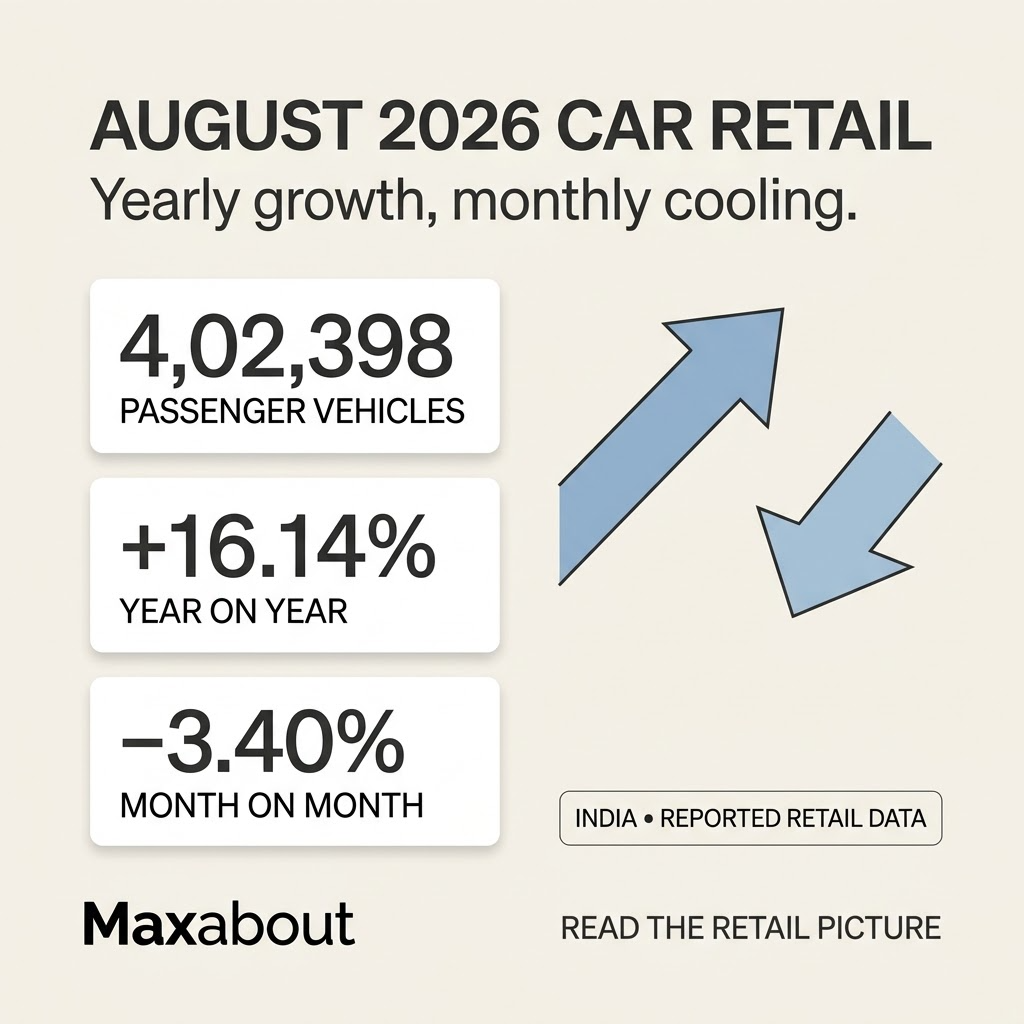
India's passenger-vehicle retail market grew year on year in August 2026, but softened compared with July. Reported retail sales reached 4,02,398 units, up 16.14% from August 2025 and down 3.40% month on month. Those two comparisons describe different trends: a stronger result against the previous y...
Editorial Team
India's passenger-vehicle retail market grew year on year in August 2026, but softened compared with July. Reported retail sales reached 4,02,398 units, up 16.14% from August 2025 and down 3.40% month on month. Those two comparisons describe different trends: a stronger result against the previous year's base alongside a quieter month than the immediately preceding one.
August 2026 passenger-vehicle retail at a glance
| Measure | Reported result | Comparison |
|---|---|---|
| Passenger-vehicle retail | 4,02,398 units | August 2026 |
| Year-on-year change | +16.14% | Against August 2025 |
| Month-on-month change | −3.40% | Against July 2026 |
These are retail figures. They should not be substituted for a manufacturer's wholesale dispatches to dealers. A change in dealer deliveries and a change in customer retail can move differently in the same month, so rankings or growth rates should be compared within a consistent dataset.
Maruti leads; Tata records strong yearly growth
Maruti Suzuki remained the largest passenger-vehicle retailer in the reported table, with 1,65,200 units and a 41.05% share. Tata Motors followed with 57,841 units, ahead of Mahindra's 50,245 and Hyundai's 46,987. Tata's 40.49% yearly increase was the strongest among the top ten entries in that table, although its retail was 1.59% lower than July.
| Carmaker | August retail | Year-on-year change | Market share |
|---|---|---|---|
| Maruti Suzuki | 1,65,200 | +22.83% | 41.05% |
| Tata Motors | 57,841 | +40.49% | 14.37% |
| Mahindra | 50,245 | +6.41% | 12.49% |
| Hyundai | 46,987 | +4.84% | 11.68% |
| Toyota | 24,856 | −9.94% | 6.18% |
| Kia | 23,371 | +17.60% | 5.81% |
Market share describes the proportion of this month's reported total. It is separate from a brand's own growth rate. A brand can sell more vehicles than a year earlier yet lose share if the overall market grows faster, as the Mahindra and Hyundai comparisons illustrate.
Why the yearly increase needs context
The broader retail reporting identifies a low comparison base in August 2025, when purchases were deferred ahead of expected tax changes. That context matters: the yearly gain should not automatically be read as an equally large acceleration in current-month buying momentum. The decline against July provides another perspective, but one monthly comparison does not establish a sustained downturn either.
The wider automotive report also shows differing movements across categories. Two-wheeler retail was reported at 17,14,610 units, up 19.69% yearly but down 5.70% monthly. Commercial-vehicle retail reached 90,769 units, up 14.45% yearly and down 8.93% monthly. These category totals should remain separate from passenger vehicles.
Dealer stock is not a delivery waiting period
Reported passenger-vehicle inventory coverage was 38–40 days. This is a dealer-stock measure, not a promise that an individual buyer will wait that long for a car. Availability still depends on the model, variant, colour, location and allocation. A national stock figure cannot tell a buyer whether their exact configuration is immediately available.
For someone buying now, the practical follow-up is to ask the dealer about the manufacturing month, actual stock status and written delivery commitment. The retail report can explain the market backdrop, but it does not establish a particular discount or guarantee negotiation room on every vehicle.
Frequently asked questions
Did August car retail rise or fall?
Both descriptions can be correct when the comparison is stated: it rose 16.14% against August 2025 and fell 3.40% against July 2026.
Are these factory dispatch numbers?
No. This article uses reported retail data. Wholesale dispatches are a separate measure and should not be mixed into the same ranking.
Does higher retail mean a particular car is better?
No. Aggregate sales measure market activity. They do not replace a model-specific assessment of safety, suitability, ownership costs or service support.
August 2026 car retail shows annual growth with monthly moderation. Keeping the comparison period and retail scope visible makes the figures useful without overstating what they say about demand or an individual purchase.
Explore the story
Related news


Share your view and join the discussion.
Earn reward points for every comment and get a chance to win ₹1,000 in our weekly lucky draw. Sign in with Google in one tap.
Start the conversation
No one has commented on this article yet. Be the first to share your view.
Want to read more automotive news?
Stay updated with the latest car launches, reviews, and industry insights.
Browse All News