
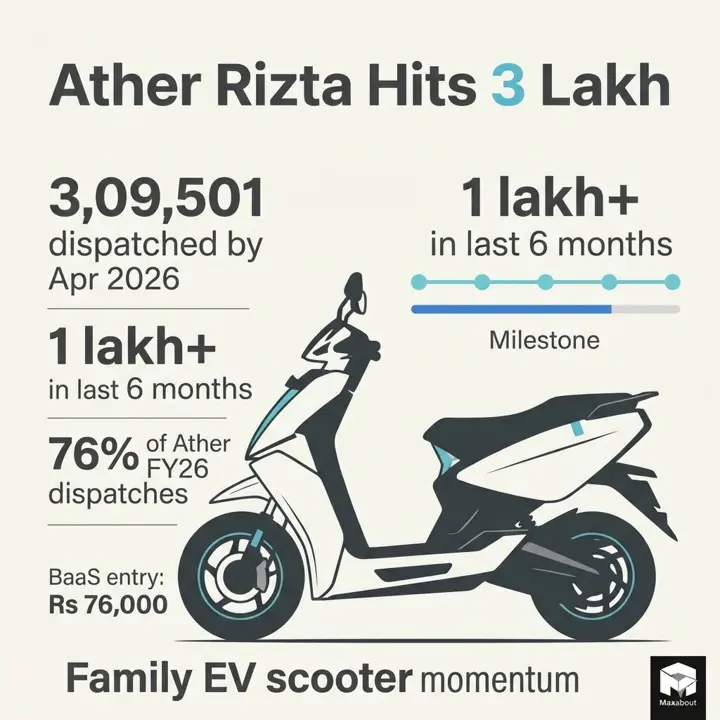
Ather Rizta Hits 3 Lakh Sales – 76% of FY26 Total
Three lakh units in two years. That is not a number you casually scroll past. When Ather Energy announced that the Rizta had crossed this milestone, my first reaction was genuine surprise — not because the scooter is bad, but because reaching this scale, this fast, in the Indian electric two-wheeler...
Editorial Team
Three lakh units in two years. That is not a number you casually scroll past. When Ather Energy announced that the Rizta had crossed this milestone, my first reaction was genuine surprise — not because the scooter is bad, but because reaching this scale, this fast, in the Indian electric two-wheeler space still feels remarkable.
What makes this more telling is the internal story. The Rizta now accounts for 76% of Ather's total FY26 sales. That is not a popular product — that is essentially the entire business holding itself up. For a brand that built its reputation on the performance-focused 450 series, this is a significant shift in identity.
And I think that shift matters beyond just Ather. It suggests something broader is changing. Indian families — not enthusiasts, not early adopters — are genuinely warming up to electric scooters as everyday transport. The Rizta was designed with exactly that buyer in mind: practical, comfortable, family-friendly.
But here is the honest question worth sitting with. Is this momentum real, or is it being carried by a favorable pricing window, subsidies, and novelty? Three lakh sales is impressive. Whether that trajectory holds as competition intensifies and incentives potentially shrink — that is the conversation worth having.
How the Rizta Became Ather's Most Important Product Almost Overnight
To understand why the Rizta matters so much, you have to understand what Ather was before it arrived. The 450 series built a loyal following — tech-savvy, performance-oriented buyers in metros who wanted a smart, quick electric scooter. That audience was real, but it was also relatively narrow.
 The Rizta was a deliberate step in a different direction. Larger footboard, softer suspension tuning, deeper storage — every design choice signaled that Ather was no longer speaking only to the enthusiast. They were talking to the family in Nagpur deciding whether one scooter could handle school runs, grocery trips, and a weekend outing without complaint.
From what industry observers noted at launch, the positioning was unusually clear for a brand that had previously leaned heavily into performance credentials. Ather seemed to acknowledge, almost openly, that the next phase of electric scooter adoption would be won in living rooms and practical conversations — not on spec sheets.
Targeting Tier 2 and Tier 3 cities alongside metro families gave Ather access to a significantly wider addressable market. Based on early reviews, the comfort-focused tuning resonated strongly outside large cities, where road surfaces are unpredictable and buyers prioritize reliability over performance figures. That strategic calculation, in hindsight, looks extremely well-timed.
Breaking Down the 76% Figure: What It Says About Ather's Sales Mix
Numbers rarely lie, but they do tell complicated stories. The Rizta accounting for 76% of Ather's total FY26 sales is not simply a success metric — it is a structural reality that deserves honest examination from both sides.
On one hand, that concentration reflects genuine market validation. Buyers chose the Rizta repeatedly, consistently, across geographies. That kind of sustained preference is not accidental. On the other hand, having three-quarters of your revenue volume sitting on a single model creates a vulnerability that industry analysts would flag immediately.
For context, well-balanced two-wheeler portfolios — as seen across established players in industry reports — typically aim for no single model exceeding 50 to 55% of total volume. It distributes risk, protects margins during demand shifts, and keeps multiple product lines competitively sharp. Ather currently sits well outside that comfort zone.
This raises an uncomfortable question about the 450 series. Once Ather's flagship and the product that built its performance-oriented identity, the 450X and 450S now appear increasingly overshadowed. Whether that is a permanent repositioning or a temporary sales cycle effect remains worth watching closely.
The real strategic dilemma for Ather now is straightforward — diversify the portfolio or double down on the Rizta's momentum? Both paths carry genuine risk. Spreading resources thin could dilute the Rizta's competitive edge, while ignoring portfolio balance leaves Ather exposed if buyer sentiment shifts even slightly.
Who Is Actually Buying the Rizta? Understanding the Real Buyer Profile
The sales numbers tell one story. But the more interesting question is who exactly is walking into Ather showrooms and choosing the Rizta over everything else available right now.
From observed trends and owner reviews, the picture becomes surprisingly clear. This is largely a family-first buyer — someone in Pune, Hyderabad, or Bangalore who needs a reliable second vehicle for daily household errands. School runs in the morning, office commutes under 35 to 40 kilometres, evening grocery trips. The Rizta fits neatly into that rhythm.
A significant portion of buyers appear to be upgrading directly from petrol scooters — the Activa loyalist who has finally done the charging math and realised home charging genuinely makes sense. That psychological shift matters enormously. Once someone installs a home charger, range anxiety drops considerably. Most daily urban routes in Indian cities rarely cross 25 kilometres, which makes the Rizta's real-world range feel entirely comfortable.
Increasingly, buyers from Jaipur, Lucknow, and similar tier-two cities are entering this segment too — drawn by lower running costs and the practical reality of dense city traffic where a compact scooter simply works better than a larger vehicle.
Parking constraints in apartment complexes and the ability to charge overnight are quietly becoming genuine purchase drivers for this buyer profile.
Strengths That Drove the Numbers: What the Rizta Gets Right
So what actually makes the Rizta worth buying? Based on reviews and owner community feedback, a few things stand out quite clearly.
The most talked-about practical feature is the 30-litre underseat boot space — genuinely large enough for a full-face helmet, which sounds basic but is something many electric scooters still get wrong. Seating comfort for two adults also draws consistent praise. Reviewers note the wide, flat platform feels more stable for pillion riders than most rivals in this segment.
From what owners report in real-world Indian riding conditions — stop-start city traffic, mixed road quality — the Rizta S variant delivers somewhere between 100 to 115 kilometres per charge, which is enough for most daily use without anxiety.
The IP67 rating is a quiet but important detail. Monsoon riding in cities like Mumbai or Chennai is a legitimate concern, and knowing the scooter's electrical components are properly sealed does matter.
Ather's ProConnect subscription brings connected features through the Ather app — ride analytics, remote diagnostics, navigation — and the OTA update capability means the scooter genuinely improves over time without a workshop visit.
Service network maturity has also improved considerably from Ather's early days. The expansion into tier-two cities has reduced a key hesitation point for buyers outside metros.
Honest Concerns: Where the Rizta Still Leaves Room for Improvement
That said, three lakh sales do not automatically mean three lakh completely satisfied owners. Some recurring concerns deserve an honest look.
The subscription model for features is something that genuinely bothers a section of buyers. Certain capabilities that feel like they should come standard — navigation, detailed ride analytics — sit behind a recurring payment. When you are already spending ₹1.4 lakh or more on a family scooter, paying additionally to unlock features already built into the hardware feels uncomfortable. Rivals like the TVS iQube and Bajaj Chetak do not create that friction.
Charging time remains a practical concern for households without fast-charger access. On a standard home plug, topping up significantly takes hours. For genuinely daily-use families, that requires planning discipline most people do not want.
Ather's service network, while growing, still has real gaps in smaller towns and rural areas. Legacy brands have decades of dealer infrastructure. That gap matters when something needs urgent attention.
Then there is the long-term battery question. Early owner data available publicly suggests most batteries are holding reasonably well, but the Rizta has not been around long enough for confident conclusions. Battery degradation over five-plus years remains an open question — one worth considering before committing.
What 3 Lakh Sales Means for the Broader Indian Electric Scooter Market
Step back from the Rizta specifically, and this milestone tells a more interesting story. For years, the conventional wisdom was simple — Indian buyers prioritize price above everything else. The cheapest option wins. Always. The Rizta's numbers quietly challenge that assumption.
This is a premium-positioned electric scooter, not an entry-level machine chasing the bottom of the market. And yet, three lakh families chose it. That matters enormously for how manufacturers, investors, and policymakers think about where Indian EV adoption is actually heading.
The broader electric two-wheeler segment has been gaining real ground in the commuter space. Industry data consistently shows electric scooters eating into petrol scooter market share — slowly at first, then noticeably. Ather's growth is part of that larger shift, not separate from it.
This creates genuine pressure on legacy ICE manufacturers. Honda, TVS, and Hero have built their scooter dominance over decades, but commuter loyalties are visibly loosening. Government support through FAME subsidies and state-level EV purchase incentives has helped reduce the upfront cost gap — making the decision easier for fence-sitters.
For competing EV startups, the pressure reads differently. Ather has demonstrated that build quality and software experience can justify a higher price point. That raises the bar for everyone else in the segment.
Looking Ahead: Can Ather Keep This Momentum Going Through FY27 and Beyond?
Three lakh units in two years is a genuine achievement. But sustaining that pace is a different challenge altogether — and the road ahead has some real obstacles worth acknowledging honestly.
Ola Electric still operates at a scale Ather cannot easily match. TVS is expanding its iQube lineup aggressively, and newer entrants are arriving with competitive pricing. The initial wave of early adopters has largely converted. What comes next requires reaching buyers who are more price-sensitive and less brand-driven — a harder audience to convince.
The Rizta's sales mix being 76% of Ather's FY26 total also raises a structural question. That concentration, while impressive, signals limited portfolio depth. From what industry observers are noting, Ather's next logical move could be an entry-level scooter pushing closer to the ₹1 lakh mark, or perhaps a serious push into electric motorcycles — a segment still largely wide open.
Geographic expansion into Tier 2 and Tier 3 cities also remains an unfinished priority. Service network confidence matters enormously outside metro areas.
In my view, what the Rizta milestone genuinely represents is something quieter but meaningful — proof that Indian buyers will choose a well-engineered, thoughtfully built electric vehicle when it respects their intelligence. That, more than any sales number, feels worth holding onto.
Explore the story
Related news
Share your view and join the discussion.
Earn reward points for every comment and get a chance to win ₹1,000 in our weekly lucky draw. Sign in with Google in one tap.
Start the conversation
No one has commented on this article yet. Be the first to share your view.
Want to read more automotive news?
Stay updated with the latest car launches, reviews, and industry insights.
Browse All News