
Ather and LICO Partner to Recycle End-of-Life EV Batteries in India
Ather Energy and LICO Materials have announced an end-of-life lithium-ion battery pathway for Ather electric two-wheelers in India. The arrangement links collection through Ather’s service ecosystem with technical assessment, potential second-life use and material recovery at LICO’s Karnataka operat...
Editorial Team
Ather Energy and LICO Materials have announced an end-of-life lithium-ion battery pathway for Ather electric two-wheelers in India. The arrangement links collection through Ather’s service ecosystem with technical assessment, potential second-life use and material recovery at LICO’s Karnataka operation. It is a circular-economy framework rather than a new battery-replacement scheme: neither company has announced customer pricing, a collection-volume target, a rollout timetable or a guaranteed second-life outcome for an individual pack.
What is confirmed
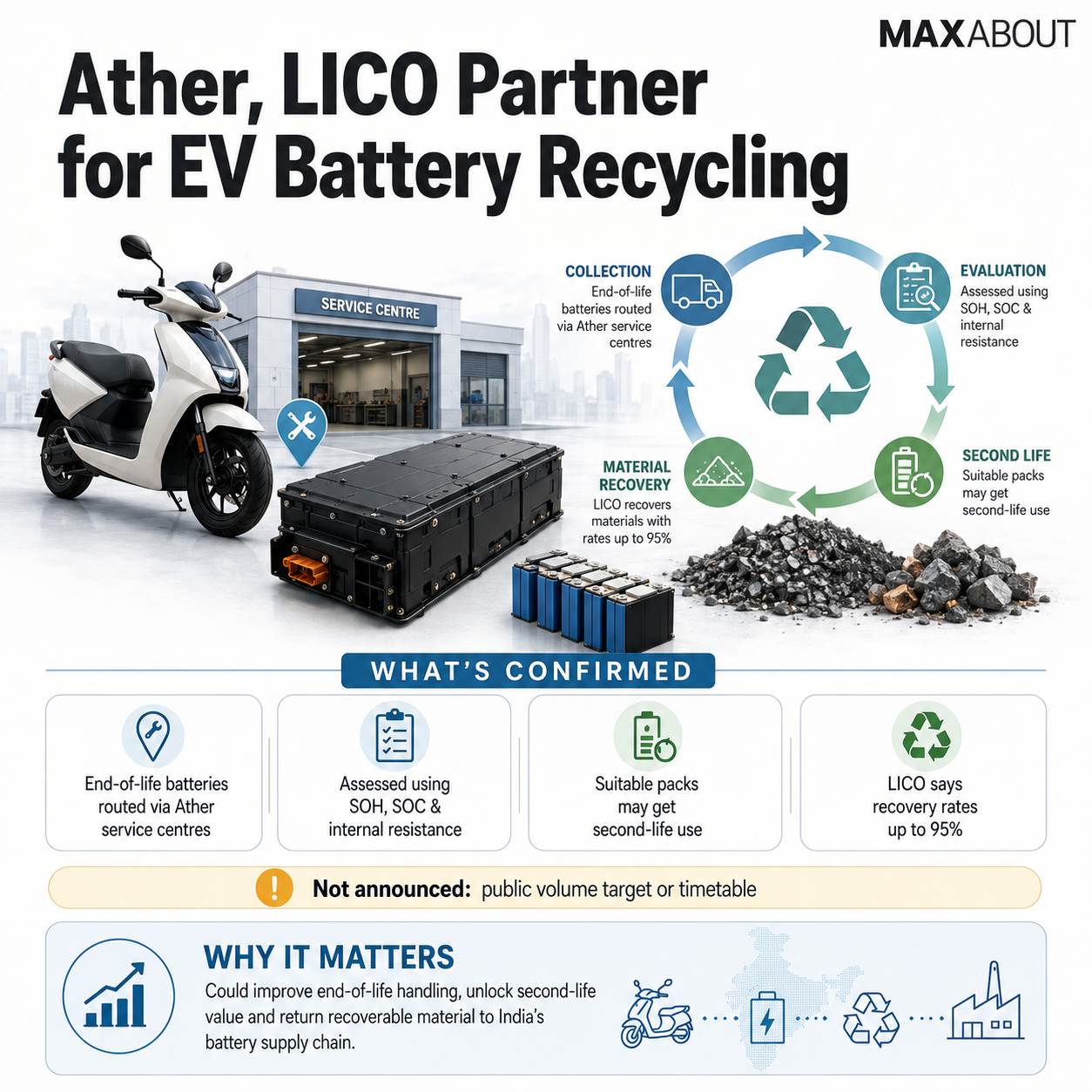
Ather will route end-of-life lithium-ion batteries through its service-centre network to LICO Materials.
Packs are expected to be assessed using state of health, state of charge and internal resistance before the next step is chosen.
Packs with useful remaining life may be considered for lower-demand second-life applications; others can be processed for material recovery.
LICO says recovered material can re-enter India’s battery supply chain and cites recovery rates of up to 95%.
How the Ather–LICO battery loop is expected to work
A battery reaching the end of its vehicle role is not automatically at the end of its usable life. Under the announced flow, a pack enters an end-of-life channel through Ather’s network and is evaluated. Health, remaining charge and internal resistance are among the reported assessment indicators. If the pack is technically suitable, it may be repurposed for a less demanding stationary or second-life role. If it is not, LICO can process it for recovery.
The collaboration has been described as a route for materials including lithium, nickel, cobalt, graphite and copper to move back toward domestic cell makers and OEM supply chains. The chemistry, condition and processing route of a particular pack will determine what can actually be recovered; an “up to 95%” recovery statement is LICO’s cited capability, not a blanket promise for every Ather battery.
What it means for Ather owners
The immediate takeaway for riders is a clearer end-of-life direction, not a new transaction. Ather has not announced that owners must return a battery now, nor has it published an out-of-warranty replacement price, buyback value or recycling incentive. Owners should continue to use authorised service channels for battery-health concerns and follow any future collection instructions issued by Ather.
The important structural change is the connection between the service point where a pack is identified and a specialist downstream handler. That can reduce the risk of a high-voltage pack entering an informal scrap route while making reuse-versus-recycling decisions more traceable. It can also make disposal planning easier for operators with multiple scooters.
Second life versus recycling
Second life means using a battery that is no longer ideal for traction in a scooter in an application with lower power or range demands. Recycling means dismantling and processing the pack to recover usable materials. The former aims to extend a pack’s service; the latter aims to return material to the production chain. They are complementary routes, not interchangeable promises.
Why it matters for India
India depends heavily on imported critical minerals and battery inputs. Recovering material from domestic end-of-life packs can help build a more circular local supply chain, although this one partnership does not by itself prove a closed-loop battery or remove import exposure. It creates the collection-to-processor link required for a larger recycling ecosystem. LICO’s capacity and recovery figures should be treated as company claims unless independently audited for a specific programme. The broader policy direction, including battery-waste rules and critical-mineral initiatives, is also pushing manufacturers and recyclers toward traceable collection and recovery systems.
What has not been announced
| Question | Current position |
|---|---|
| Will every retired pack get a second life? | No. A technical assessment is expected to decide whether reuse is appropriate. |
| Is there a public owner buyback or recycling incentive? | Not announced. |
| How many batteries will be processed? | No volume target has been announced. |
| When and where does collection start? | The service-network pathway is announced, but a public timetable and geography are not detailed. |
Bottom line
The Ather–LICO tie-up matters because it connects an EV maker’s service ecosystem to a recycler that can assess, repurpose or recover end-of-life battery materials. For buyers, it is a positive framework rather than a promised benefit or payout. The next useful disclosures would be owner-facing collection instructions, processed volumes, audit-backed recovery data and evidence that recovered material is fed back into Indian battery manufacturing.
FAQs
Does this mean Ather will replace old batteries for free?
No such offer has been announced.
What does LICO do with Ather packs?
LICO is expected to assess packs for possible second-life use or process them to recover materials.
Is the 95% recovery claim guaranteed?
No. LICO cites recovery rates of up to 95%; actual outcomes depend on chemistry, condition and processing.
Explore the story
Related news
Share your view and join the discussion.
Earn reward points for every comment and get a chance to win ₹1,000 in our weekly lucky draw. Sign in with Google in one tap.
Start the conversation
No one has commented on this article yet. Be the first to share your view.
Want to read more automotive news?
Stay updated with the latest car launches, reviews, and industry insights.
Browse All News