
2027 Hyundai Grandeur Facelift: New Display and Smart Roof for India
2027 Hyundai Grandeur Facelift: What's New for India?The 2027 Hyundai Grandeur facelift represents a significant step in Hyundai's global luxury sedan strategy, and it might finally be time for Indian buyers to get excited. While Hyundai has traditionally focused on mass-market vehicles in India, th...
Editorial Team
2027 Hyundai Grandeur Facelift: What's New for India?
The 2027 Hyundai Grandeur facelift represents a significant step in Hyundai's global luxury sedan strategy, and it might finally be time for Indian buyers to get excited. While Hyundai has traditionally focused on mass-market vehicles in India, their premium segment ambitions have been growing steadily with models like the Tucson and Alcazar.
The standout features of this facelift are genuinely impressive. The massive 17-inch display brings technology front and center, while the innovative Smart Vision Roof transforms the cabin experience with advanced lighting and transparency controls. These aren't just incremental improvements—they represent a clear vision of where premium sedans are heading.
I believe the timing could be right for Hyundai to introduce the Grandeur in India. As more buyers look beyond the usual German luxury suspects, there's room for a technology-focused premium sedan with Hyundai's proven reliability and service network behind it. The question is whether Hyundai will position it as a flagship halo product or commit to serious volumes in the ₹35-45 lakh segment.
Design Evolution: Exterior Changes and Smart Vision Roof
The 2027 Grandeur facelift brings subtle yet meaningful exterior refinements to Hyundai's flagship sedan. The front fascia now features a more pronounced grille with parametric jewel patterns that create a sophisticated light play. The LED headlights have been slimmed down further, enhancing the horizontal emphasis that makes the car appear wider and more planted.
The most revolutionary addition is the Smart Vision Roof, which represents a significant leap beyond traditional panoramic sunroofs. Unlike conventional fixed-glass sunroofs common in Indian premium vehicles from Skoda, Toyota, and Mercedes, this system uses electrochromic glass with embedded micro-LED elements that can display information or adjust transparency levels based on sunlight intensity.
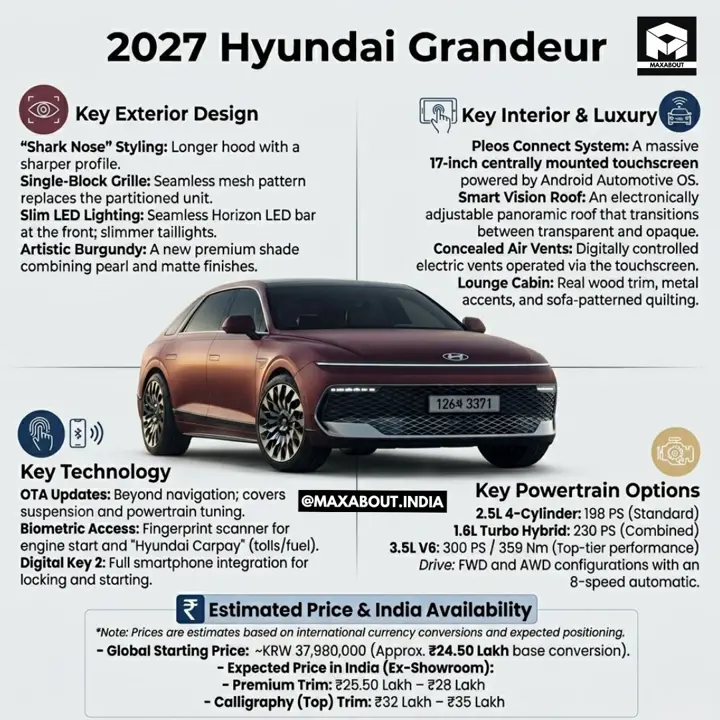 For the Indian context, I think this technology addresses several practical concerns. During our intense summers, the Smart Vision Roof can automatically darken to block up to 99% of UV radiation while still maintaining visibility—much more effective than the manual sunshades in current premium cars. The roof can also display warning messages or ambient lighting patterns, adding both safety and customization options.
The side profile maintains the current model's fastback silhouette but adds sharper character lines and redesigned 19-inch alloy wheels. At the rear, connected LED light bars create a distinctive nighttime signature that elevates the car's premium appearance.
While impressive, I wonder if this technology might face challenges with our dusty conditions and extreme heat. Maintenance costs and part replacement for such advanced systems could be steep in the Indian market. Still, for buyers seeking distinction beyond the usual luxury offerings, these innovations could be compelling differentiators.
Interior Revolution: The 17-Inch Display and Cabin Upgrades
Stepping inside the 2027 Grandeur reveals what I consider the most dramatic upgrade: a stunning 17-inch panoramic display that dominates the dashboard. This isn't just a larger screen - it represents a fundamental rethinking of driver-vehicle interaction. The curved display houses both instrument cluster and infotainment functions, with remarkably crisp graphics and responsiveness that puts it in contention with Mercedes' MBUX and BMW's iDrive systems.
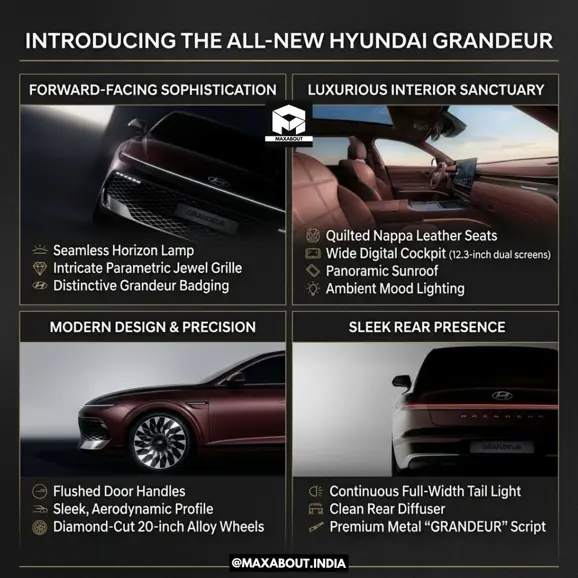 The cabin materials have received substantial upgrades too, with premium leather, real wood inserts, and ambient lighting that creates a genuinely luxurious atmosphere. I'm particularly impressed by the new Smart Vision Roof that can adjust transparency electronically - perfect for enjoying mild winter sunshine in Delhi while blocking harsh summer rays in Chennai.
Space utilization feels excellent, with ample rear legroom that would please chauffeur-driven executives in Mumbai or Bengaluru. The acoustic insulation seems substantially improved - something I imagine would be welcome during monsoon downpours or noisy city traffic.
What might concern Indian buyers is whether Hyundai's aftersales network can properly maintain such advanced technology compared to established luxury brands. Additionally, while ₹45-50 lakh (my estimated price if launched here) represents value against German rivals costing ₹65 lakh+, it's still substantial money for a Hyundai badge in our status-conscious market.
Powertrains and Performance: What to Expect
For the Indian market, the 2027 Grandeur's powertrain options would likely need careful consideration. Based on global specifications, we might see a 2.5-liter naturally aspirated engine paired with a smooth 8-speed automatic transmission as the base offering. This would deliver adequate power for our driving conditions, though I suspect the 3.5-liter V6 variant would be the sweet spot for those who frequently drive on our expanding expressway network.
A hybrid powertrain combining a 1.6-liter turbocharged engine with electric assistance seems most appropriate for India, potentially delivering around 18-20 km/l in mixed driving conditions. This would position it competitively against the Toyota Camry Hybrid's efficiency while offering more modern technology.
In typical Indian driving scenarios, the suspension tuning will be crucial. Hyundai generally does a good job balancing comfort and handling for our roads, but this larger platform might need specific calibration to handle our speed breakers and occasional rough patches without compromising the premium feel.
The potential inclusion of an all-electric variant by 2027 would align perfectly with India's EV push, especially for urban luxury buyers in metros who care about both status and environmental credentials. However, I think Hyundai would need to ensure proper charging infrastructure support before bringing such a variant here.
Technology and Safety Features
The 2027 Grandeur's standout tech feature is clearly the massive 17-inch display that integrates infotainment and climate controls. This looks impressive, but I wonder about its practicality on Indian roads where glare can be a real issue. The new Smart Vision Roof is another interesting addition, essentially a panoramic glass roof with adjustable transparency - perfect for our varied climate conditions.
On the safety front, the comprehensive ADAS suite includes adaptive cruise control, lane-keeping assist, and autonomous emergency braking. I think Hyundai would retain most of these for India, unlike some brands that strip features for our market. The 360-degree camera system would be particularly valuable given our chaotic traffic and tight parking spots in cities like Mumbai and Delhi.
Compared to current premium offerings like the Mercedes E-Class and BMW 5 Series in India, the Grandeur's safety package appears competitive, though I suspect some of the more advanced driver assistance features might be calibrated differently for our driving conditions.
The connected car features with OTA (over-the-air) updates would be relevant for tech-savvy Indian buyers who expect their vehicles to match their smartphone experience. For passive safety, the multiple airbags and reinforced structure would address growing safety consciousness among premium car buyers here, especially after the implementation of Bharat NCAP.
Market Positioning and Expected Pricing in India
If launched in India, the 2027 Hyundai Grandeur would likely sit at the top of Hyundai's portfolio, positioned above the Tucson and Alcazar. It would represent Hyundai's attempt to break into the premium segment currently dominated by German luxury brands.
Price-wise, I'd expect the Grandeur to start around ₹45-50 lakh, potentially climbing to ₹60 lakh for fully-loaded variants. This positions it interestingly - more expensive than the Tucson (₹29-35 lakh) but offering better value than entry-level luxury sedans like the BMW 3 Series or Mercedes C-Class (₹55-65 lakh range).
The question is whether Indian consumers would accept a premium Hyundai at these prices. Based on the lukewarm reception of previous flagship attempts like the Sonata, there's hesitation around luxury pricing from mainstream brands. However, Hyundai's brand perception has improved significantly, and the Grandeur's technology-forward approach might appeal to buyers who prioritize features over badge prestige.
The value proposition would need to be exceptional, offering substantially more equipment than European rivals at a 15-20% discount to overcome brand snobbery that still exists in the luxury segment.
Should You Wait for the Grandeur in India?
The question of whether to wait for the Grandeur in India depends largely on your specific needs. If you're shopping in the ₹40-50 lakh segment right now, established options like the Skoda Superb, Toyota Camry, and entry-level German luxury sedans offer proven value propositions with established service networks.
From what I've observed, Hyundai's after-sales experience, while improving, doesn't yet match the personalized service that luxury brands provide. This becomes crucial when investing in a premium vehicle. Resale value is another concern – flagship sedans from mainstream brands historically depreciate faster than their German counterparts in India.
For tech enthusiasts and early adopters, the Grandeur's 17-inch display and innovative features might be worth the wait. However, practical buyers should consider:
The uncertainty of Hyundai's pricing strategy
Limited service expertise for flagship models
Potential first-generation issues in a new market
In my view, the Grandeur could succeed in India if priced around ₹35-40 lakh, positioned as a technology-forward alternative to European entry-luxury vehicles. For most buyers, though, I'd recommend exploring existing options rather than waiting for what remains an uncertain launch with unpredictable pricing and positioning.
Explore the story
Related news

Share your view and join the discussion.
Earn reward points for every comment and get a chance to win ₹1,000 in our weekly lucky draw. Sign in with Google in one tap.
Start the conversation
No one has commented on this article yet. Be the first to share your view.
Want to read more automotive news?
Stay updated with the latest car launches, reviews, and industry insights.
Browse All News