
2026 Hyundai Creta Summer Edition Launched at ₹12.05 Lakh
Summer in India hits differently. The heat is relentless, the roads are packed with families rushing to hill stations, and dealerships are buzzing with buyers who've finally made their decision. Hyundai clearly knows this. The launch of the 2026 Hyundai Creta Summer Edition at ₹12.05 lakh is timed a...
Editorial Team
Summer in India hits differently. The heat is relentless, the roads are packed with families rushing to hill stations, and dealerships are buzzing with buyers who've finally made their decision. Hyundai clearly knows this. The launch of the 2026 Hyundai Creta Summer Edition at ₹12.05 lakh is timed almost perfectly — and that's not a coincidence.
The Creta doesn't really need an introduction in India. It's been one of those vehicles that consistently tops sales charts, survives segment shifts, and somehow stays relevant no matter how crowded the compact SUV space gets. That's a rare thing. From what industry reports suggest, it remains a benchmark that every new entrant gets compared against.
So when Hyundai drops a special edition with a price tag that undercuts what most people expect, it naturally raises two questions. Is this genuinely feature-packed value? Or is it mostly a seasonal badge exercise with some cosmetic additions dressed up as news?
This article works through exactly that. We'll look at the pricing strategy, what's actually new, how it sits against rivals, and whether the Summer Edition tag carries real substance. Because in a market this competitive, buyers deserve a straight answer — not just marketing language.
Pricing Breakdown: Is ₹12.05 Lakh the Right Entry Point?
The ₹12.05 lakh ex-showroom figure positions this Summer Edition on the base-to-mid variant spectrum of the Creta lineup. That's an important distinction. You're not getting the fully loaded Creta experience here — but you're also not starting from the absolute ground floor.
On-road prices tell a different story. Factor in registration, insurance, and handling charges, and the numbers shift considerably across cities. In Mumbai, expect roughly ₹13.8 to ₹14.1 lakh on-road. Delhi buyers might see something closer to ₹13.5 lakh. Bengaluru and Chennai typically land between ₹13.6 and ₹14 lakh depending on dealer charges.
From a middle-class affordability standpoint, a ₹14 lakh on-road price at standard EMI tenures means roughly ₹22,000 to ₹25,000 monthly over five years — assuming a modest down payment. That's a real commitment for most households.
Compared to the standard Creta lineup, Hyundai appears to have priced this conservatively rather than aggressively. The premium over a comparable base variant is marginal, which makes the Summer Edition feel like a reasonable lateral option rather than a bold value statement. Whether the added features justify even that small difference is the real question worth examining next.
New Features Added: What the Summer Edition Actually Brings to the Table
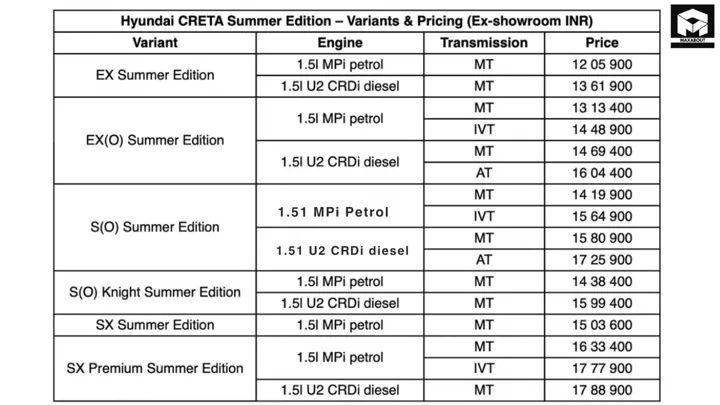
So, does the Summer Edition actually deliver something meaningful, or is it mostly a marketing exercise dressed up in seasonal packaging? Honestly, it's a bit of both — and I think it's worth being upfront about that.
The most genuinely useful addition for Indian conditions is the ventilated front seats. If you've ever sat in a parked car during a May afternoon in Nagpur or Chennai, you understand exactly why this matters. Fabric seats turn into heat traps. Ventilated seats actively pull air through the cushioning, and the difference during those first few minutes of driving is noticeable. This isn't a gimmick — it's a practical upgrade that addresses a real daily frustration.
Alongside that, Hyundai has reportedly included a cabin air purification system with an enhanced filter setup. Given the air quality in cities like Delhi and Mumbai during summer dust storms, this has legitimate value beyond just the hot-weather angle.
On the cosmetic side, the Summer Edition gets exclusive exterior colour options and special badging that distinguishes it from the standard lineup. The interior also receives a refreshed upholstery treatment. These changes look sharp, but they're purely visual — no functional benefit in 42-degree heat.
From what industry reports suggest, the connected car features remain largely unchanged from the existing Creta's BlueLink suite. No significant infotainment upgrade has been confirmed, which is a mild disappointment if you were hoping for something more substantial on the tech front.
In summary — the ventilated seats alone arguably justify the marginal price premium. Everything else feels like thoughtful packaging rather than genuine innovation.
How Does It Perform in Real Indian Driving Conditions?
Features on paper mean little if the car struggles through Pune's pothole-riddled inner lanes or sits suffocating in Hyderabad's afternoon traffic. So the more important question — how does the 2026 Creta platform actually hold up day-to-day?
From what reviewers have noted, the ride quality strikes a reasonable balance. Ground clearance sits at approximately 190mm, which handles most broken state roads and speed breakers without drama. Not perfect, but genuinely adequate for urban Indian realities.
The air conditioning is where the Summer Edition's positioning makes most sense. Based on test drive reports from hotter regions, the Creta's cooling system reaches comfortable cabin temperatures relatively quickly — a meaningful advantage when ambient temperatures cross 42°C. The ventilated seats work best when the AC is already running, so together they create a noticeably more bearable experience on long stationary stretches.
Engine behaviour in stop-and-go traffic varies across options. The naturally aspirated 1.5-litre petrol feels smooth but requires frequent gear changes in dense city conditions. The turbo petrol manages better with its torque spread. From what observers have reported, the strong hybrid variant genuinely shines here — switching seamlessly to electric mode during crawling traffic, reducing both heat and fuel consumption considerably.
Cabin noise levels are reasonably controlled at city speeds, though highway wind intrusion above 100kmph has been mentioned in several test drive reports as a minor but persistent concern.
Fuel Efficiency: What to Realistically Expect in City and Highway Use
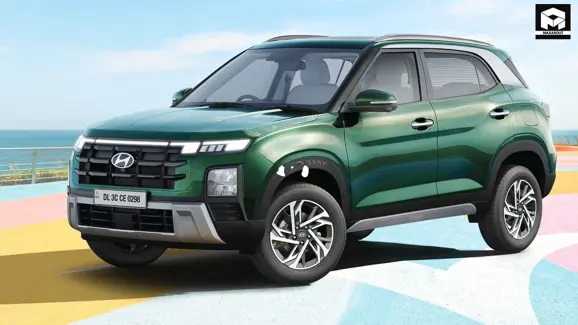
Hyundai quotes ARAI figures of around 17–18 kmpl for the 1.5-litre naturally aspirated petrol, roughly 20 kmpl for the diesel, and considerably higher numbers for the strong hybrid variant. Impressive on paper. Real-world driving, however, tells a different story — especially in Indian summers.
In stop-and-go city traffic like Bengaluru's Outer Ring Road or Delhi's Lajpat Nagar stretch during peak hours, the naturally aspirated petrol will realistically deliver somewhere between 11–13 kmpl. The AC working overtime in 40-degree heat pulls efficiency down noticeably. That's just honest math.
The strong hybrid genuinely earns its premium in these conditions. Electric mode kicks in frequently during crawls, keeping the engine off and reducing the AC-related load on fuel consumption. Based on owner feedback from similar Hyundai hybrid platforms, real-world city figures around 18–20 kmpl are credible — a meaningful gap over conventional options.
On highways, things improve across the board. The diesel and turbo petrol both settle comfortably into 17–19 kmpl range at steady 80–90 kmph cruise. Summer heat has less impact here since ventilation demands are comparatively lower with good airflow.
Bottom line — if your daily commute is genuinely city-heavy and summer-long, the hybrid variant's efficiency advantage is real, not just a brochure claim.
Pros and Cons of the 2026 Hyundai Creta Summer Edition
After going through everything this variant brings to the table, here is my honest read on whether it actually makes sense for buyers considering it right now.
What Works in Its Favour
The pricing is genuinely competitive. At ₹12.05 lakh, Hyundai has positioned this carefully — not too far above the standard variant to feel unjustified, but loaded enough to feel like a real upgrade. For a nameplate with Creta's resale strength, that matters. Resale values on Cretas have historically held well across Indian markets, and this edition is unlikely to break that pattern.
Hyundai's service network across India remains one of the strongest in the segment. Whether you are in Pune, Lucknow, or a smaller town in Rajasthan, finding authorised service support is rarely a problem. That kind of reliability in after-sales is something first-time buyers especially should weigh seriously.
The summer-specific features — ventilated seats, enhanced cabin cooling, UV-cut glass — are not gimmicks in the Indian context. Anyone who has sat in a parked car in Delhi or Chennai in May understands exactly why these additions matter.
Where It Falls Short
That said, a few concerns are worth being upfront about. The premium over a comparable standard variant needs scrutiny. If the features added are primarily comfort-focused rather than safety or powertrain upgrades, some buyers may find the price difference harder to justify — particularly those who already use sunshades and parking covers as workarounds.
Waiting periods could also be a real issue. Edition-specific variants from Hyundai have historically attracted strong initial demand, and delivery timelines stretching beyond six to eight weeks are a genuine possibility in metro markets.
Long-term reliability of the newer additions — particularly the ventilation system and any software-linked features — remains to be seen over multiple Indian summers.
How Does the Creta Summer Edition Compare to Key Rivals?
At ₹12.05 lakh, the Creta Summer Edition sits in genuinely competitive territory. This is not a price point Hyundai can afford to be complacent about.
The Maruti Grand Vitara at comparable pricing offers strong hybrid efficiency — a real advantage for city commuters covering long daily distances. Its service network is arguably the most widespread in India, stretching into smaller towns where Hyundai dealerships are still catching up. If fuel bills and long-term running costs are your primary concern, the Grand Vitara makes a compelling case.
The Kia Seltos feels more feature-rich in certain trim configurations and shares mechanical DNA with the Creta, which keeps ownership costs predictable. From what reviewers consistently note, the Seltos has a slightly more premium cabin feel. However, its pricing often climbs faster once you start adding variants.
The Tata Curvv brings fresher styling and strong safety credentials, appealing to buyers who prioritize design and NCAP ratings over brand legacy.
In my view, the Creta Summer Edition suits buyers who specifically value Hyundai's established resale value and service reliability — both genuinely strong in this segment — and who want comfort-focused features rather than pure performance. If you drive frequently in Bengaluru or Delhi traffic, the cooling-oriented additions make practical sense. But purely on features-per-rupee, rivals deserve serious consideration.
Should You Buy the 2026 Hyundai Creta Summer Edition? Final Verdict
So here is the honest answer: this edition makes sense for a specific type of buyer, not everyone. If you are upgrading from a hatchback and want a feature-loaded SUV entry point with minimal ownership stress, the Creta Summer Edition at ₹12.05 lakh is genuinely compelling. Hyundai's service network alone — spanning even smaller tier-2 cities — removes a lot of post-purchase anxiety.
First-time SUV buyers and families prioritizing comfort over performance will likely feel well-served here. The cooling-focused additions are not gimmicks in a country where summer cabin temperatures routinely cross unbearable levels before you even start the engine.
That said, is the premium over a standard Creta variant justified? From what I have seen, the edition-specific features are meaningful but not transformative. If festive season deals are a few months away, waiting could get you better financing terms or exchange bonuses that effectively close the price gap.
Before booking, I would strongly recommend visiting your nearest Hyundai dealership for a test drive, checking the exact on-road price in your city — it varies noticeably between Mumbai and smaller markets — and asking directly about current waiting periods. Some variants have stretched timelines.
Ultimately, the Creta Summer Edition is a safe, sensible choice — not the most exciting one. And sometimes, that is exactly what you need.
Explore the story
Related news


Share your view and join the discussion.
Earn reward points for every comment and get a chance to win ₹1,000 in our weekly lucky draw. Sign in with Google in one tap.
Start the conversation
No one has commented on this article yet. Be the first to share your view.
Want to read more automotive news?
Stay updated with the latest car launches, reviews, and industry insights.
Browse All News